Is Car Mold a Common Problem?

Is Car Mold a Common Problem?

Is Car Mold a Common Problem?

Short answer: yes — far more common than most drivers realize. Mold doesn't need much of an invitation. All it requires is moisture, warmth, and an organic surface to feed on, and the interior of your car offers all three in abundance. Fabric seats, carpet padding, foam headliners, and rubber seals are practically a buffet for mold spores. The good news is that common doesn't mean inevitable — once you understand what drives it, it's largely preventable.

24–48 HRS
How fast mold can take hold once moisture is present
LEAKS
The #1 cause of car mold — and the one most people overlook
MVOCs
The musty smell that's often the very first warning sign

What Starts Car Mold?

Mold spores are already floating in the air everywhere — harmless until they find moisture. In a car, these are the usual triggers that give them what they need:

Spills & forgotten moisture

A spilled coffee, a wet umbrella, or a soaked gym bag soaks deep into padding and foam — where it doesn't dry and you can't see it.

Humidity & condensation

In the humid Southeast, moisture cycling onto cool interior surfaces can push the cabin into the danger zone without a single spill.

Flooding & storm damage

Floodwater penetrates every interior layer; without rapid professional drying, colonies entrench within days.

Improper cleaning

Shampooed seats or steam-cleaned carpets that never fully dry become a prime environment for spores to take hold.

The big one: water leaks

Faulty door seals, cracked windshields, blocked sunroof drains, and worn weatherstripping let water in quietly — a slow leak can saturate flooring for weeks before any mold appears. Nearly every serious car-mold case traces back to a leak, which is exactly why finding and fixing the source is always step one.

What Does Car Mold Look Like — and Smell Like?

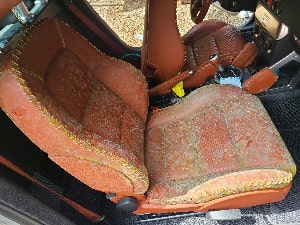
Mold in a vehicle often shows up as fuzzy or powdery patches in black, green, gray, or white — on seat seams, under floor mats, on the headliner, around door sills, or beneath the seats where spills gather and air barely moves. But it doesn't always announce itself visually.

The earliest sign is usually smell

That damp, earthy, musty odor many drivers shrug off as "old car smell" is actually microbial volatile organic compounds (MVOCs) released by active mold. If your car smells musty, take it seriously even if you can't see a thing — and know that masking it with air freshener won't fix the cause.

The Real Health Risks of Car Mold

This is where car mold shifts from an inconvenience to a genuine safety issue. The EPA links mold exposure to a consistent set of effects — and a car makes them worse, because the HVAC system circulates spores directly onto occupants every time you run the heat or A/C. Watch for:

Nasal & sinus congestion

Stuffiness and recurring sinus irritation, often worse during a drive.

Eye & skin irritation

Itchy or watery eyes and skin reactions in the enclosed cabin.

Coughing & wheezing

Airway irritation from spores suspended in recirculated cabin air.

Worsened asthma

Asthma symptoms triggered or intensified by ongoing exposure.

In higher-risk individuals

People with asthma, mold allergies, or weakened immune systems — along with children and the elderly — react more strongly, and should treat even brief exposure in a closed cabin seriously. (More on why car mold is worth taking seriously.)

Does Car Mold Hurt Your Vehicle's Value?

Absolutely. A vehicle with a visible or documented mold problem takes a real hit at resale. Mold permanently stains fabric, degrades foam padding, and can corrode metal components if left long enough — and nothing kills a sale faster than a musty-smelling cabin, since interior condition is one of the first things buyers judge. Treating it early isn't only about health; it's a smart financial decision.

How Car Mold Actually Gets Treated

Here's the honest version most "car mold" articles skip: mold isn't a cleaning problem, it's a remediation problem. A wipe-down handles what you can see; the colony lives in what you can't. Here's how it really gets addressed:

1

Act fast. The longer a colony grows, the deeper it penetrates and the costlier it is to undo. Speed is everything.

2

Inspect the scope. Pull the mats, check under seats and in the trunk, and run a flashlight along seams and door seals to find how far it reaches.

3

Know that surface treatment only buys time. Spraying or wiping won't reach mold rooted in seat foam, carpet padding, and HVAC ducts — which is why detailed or DIY-treated cars almost always relapse.

4

Dry it at the substrate. Surface drying isn't enough — padding stays soaked underneath, so trim and carpet have to be pulled back to dry the foam down to the floor pan.

5

Get professional remediation. The real fix repairs the leak, removes and replaces contaminated padding, treats the interior with chlorine dioxide — not ozone, which degrades rubber seals — purges the HVAC system, and installs a fresh MERV 13 cabin filter. That's the work Car Mold Guys does, to the ANSI/IICRC S520 standard.

How to Prevent Car Mold

Prevention is always easier than remediation. A few consistent habits go a long way:

  • Address spills immediately — blot, then pull moisture out with a wet/dry vac and aim a fan at the spot.
  • Check your weather seals annually — shut a dollar bill in the door; if it slides out easily, the seal is worn and letting moisture in.
  • Use moisture absorbers — DampRid or reusable silica canisters keep cabin humidity down, especially in humid climates.
  • Run your A/C regularly — it actively dehumidifies the cabin, even in mild weather.
  • Don't leave wet items in the car — towels, rain-soaked jackets, and damp gear are classic triggers.
  • Have your HVAC inspected — the A/C evaporator coil is a known mold growth point worth checking.

The Bottom Line: Don't Wait on Car Mold

Car mold is common, but it isn't inevitable — and it's never something to put off. The longer a colony grows, the deeper it goes, the harder it is to treat, and the more it costs you in both interior damage and health. Whether it's a faint musty odor or a full infestation after a flood, acting quickly is always the right move. Our FAQ and our guide to the types of mold found in cars are good next reads.

Don't Allow Mold to Make Your Car Its Home

If you've spotted mold or caught that musty smell, the specialists at Car Mold Guys find the leak, remove the mold at its source, and treat with chlorine dioxide — mobile to your door, backed by a 90-day warranty across GA, SC, NC, TN, FL, and AL.

Get Your Free Assessment

Sources: EPA — Mold Course · EPA — Mold, Moisture, and Your Home

Protective Gear for Mold Remediation

Protective Gear for Mold Remediation

Protective Gear for Mold Remediation: A Complete Safety Guide

Mold doesn't wait, and neither should your protection. The moment you disturb a colony, spores go airborne — and within seconds they can reach your lungs, settle on your skin, and irritate your eyes. The right protective gear isn't optional; it's the line between a safe cleanup and a new health problem on top of the one you started with. Here's the full rundown of what proper protection looks like — the same standard professionals work to — and why each piece matters.

99.97%
What P100 / HEPA-grade filters block — the pro standard
10 FT²
The EPA threshold for calling in a professional
S520
The remediation standard Car Mold Guys works to

Why Mold PPE Is Non-Negotiable

Mold colonies release two threats: spores (microscopic reproductive particles) and mycotoxins (toxic compounds produced by certain species, like the black mold Stachybotrys chartarum). Both can enter through your lungs, skin, and eyes during active work. The EPA recommends full protection for any job involving more than 10 square feet of growth, and OSHA outlines respiratory and skin protection requirements for remediation workers. The gear below isn't overkill — it's the baseline.

The Essential Gear, Piece by Piece

Respiratory protection Most Critical

An N95 handles small, contained jobs; serious work calls for a half- or full-face respirator with P100 (HEPA-grade) filters. A respirator is only as good as its seal — fit and a seal check matter as much as the filter.

Eye protection

Sealed, indirect-vent splash goggles (ANSI Z87.1) — not open safety glasses, which let microscopic spores drift right in. A full-face respirator covers this for you.

Gloves

Chemical-resistant nitrile or neoprene, long enough to pass the wrist and overlap your sleeve. Never reuse disposables — bag and discard them inside the work zone.

Protective clothing

Disposable Tyvek coveralls with elasticized wrists and ankles. Discarding them after each job is what prevents you from carrying spores home on your clothes.

Footwear protection

Waterproof rubber boots plus disposable shoe covers. Peel the covers off (inside-out) before stepping back into clean areas to avoid tracking spores out.

Head & hair

A disposable hood or bonnet keeps spores out of your hair — easy to skip, easy to regret. Many coverall suits include one built in.

Hearing protection (situational)

Not every job needs it — but if you're running industrial HEPA vacuums or air scrubbers in a confined space, add foam earplugs or earmuffs. OSHA recommends protection at sustained noise of 85 dB or above.

Taking It Off Without Undoing Your Work

How you remove contaminated gear matters as much as wearing it — do it wrong and you spread spores into clean space. Follow this exit order every time:

1

Shoe covers first. Remove them inside the contamination zone and seal them in a waste bag.

2

Coverall next. Roll the Tyvek suit inside-out from the top down, trapping any surface spores within.

3

Gloves last, using the glove-in-glove technique so bare skin never touches a contaminated surface.

4

Bag and label. Seal everything in 6-mil poly contractor bags, tape them shut, and mark them as mold-contaminated waste.

5

Service reusables. Replace P100 cartridges on schedule, and wipe down any reusable respirator facepiece with a disinfectant.

Why a car is a special case

A vehicle concentrates every risk this gear guards against. The cabin is a small, sealed space where spore counts climb fast; the HVAC system blows contaminated air straight at you and spreads colonies throughout the interior; and mold roots deep in seat foam and carpet padding where surface cleaning can't reach. That combination is exactly why car mold is hard to DIY safely — and why surface treatments relapse.

When to Call a Professional

DIY gear is fine for a small, contained spot once you've confirmed how far the mold has spread. But some situations exceed what consumer PPE and effort can safely handle:

More than 10 sq. ft. of growth — the EPA's own line for bringing in a professional.

HVAC contamination — which can spread spores through the entire vehicle.

Black mold or other toxigenic species — higher stakes, less room for error.

Mold after flooding — water reaches every layer, demanding professional drying.

In any of those cases — and for nearly any moldy vehicle — the safest call is a specialist. Car Mold Guys works to the same ANSI/IICRC S520 professional remediation standard referenced throughout this guide, using full PPE, leak repair, contaminated-padding removal, chlorine-dioxide treatment, and a full HVAC purge — all mobile, brought to your door. It's not a premium add-on to a car wash; it's a dedicated professional discipline.

The Bottom Line

Mold gives no warning before it reaches your lungs or triggers a reaction. The right protective gear — worn correctly and removed properly — is what keeps a cleanup from creating new problems. Equip yourself well for the small jobs, work smart, and when it's a car or the job is simply too big, don't hesitate to bring in the professionals who do this every day. For more on the stakes, see why car mold is worth taking seriously, and our FAQ answers the questions we hear most.

Leave the Suit and Respirator to Us

Car mold is one job better left to specialists. The team at Car Mold Guys arrives fully equipped, finds the leak, removes the mold at its source, and treats with chlorine dioxide to the IICRC S520 standard — mobile to your door, backed by a 90-day warranty across GA, SC, NC, TN, FL, and AL.

Get Your Free Assessment

Sources: EPA — Mold Cleanup · OSHA — Mold · IICRC S520

How Vast is the Mold World?

How Vast is the Mold World?

How Vast Is the Mold World? Inside One of Earth's Most Successful Organisms

Mold is one of the most successful life forms on the planet. It thrives in rainforests and on glaciers, on bread left on the counter, inside walls soaked by a slow leak — and yes, inside the interior of your car. The numbers behind that success are staggering, and understanding them is more practical than it sounds: it's knowledge that helps protect your health, your home, and your vehicle.

100K+
Mold species formally identified so far
500K
Estimated total that may exist on Earth
<200
Species that actually threaten your health or property

What Exactly Is Mold?

Mold belongs to the kingdom Fungi — neither plant nor animal. It reproduces by releasing microscopic spores into the air, which land on surfaces and germinate wherever moisture, warmth, and organic material meet. That trio is exactly why your car's interior, your bathroom ceiling, and your basement walls are all fair game. And it moves fast: once a moisture event occurs, mold can begin growing within 24 to 48 hours, which is why rapid response matters so much — whether the water came from a flood, a leaky roof, or a forgotten spilled drink in a vehicle.

How Many Types of Mold Are There?

The honest answer is: more than we've counted. Mycologists discover new species every year, especially in under-explored places — tropical rainforests, deep ocean sediments, isolated caves. And thanks to DNA sequencing, researchers can now tell apart molds that look identical, meaning a single "species" sometimes turns out to be several. The count keeps climbing. Here's where it stands today:

100,000+ mold species have been formally identified and documented.

300,000–500,000 is the current estimate of how many actually exist.

Fewer than 200 are considered significant threats to human health or buildings.

Thousands play genuinely beneficial roles in ecosystems, medicine, and food.

The Common Molds You'll Actually Meet

Out of that vast universe, a small handful of genera dominate the indoor world — homes, offices, and vehicles alike:

Aspergillus

200+ species. Some make soy sauce and miso; others cause serious infections in vulnerable people. Common on dust, food, building materials, and in HVAC systems.

Penicillium

The source of penicillin — but indoors, a fast-spreading nuisance on water-damaged paper, fabric, and leather, and a frequent cause of musty odors in homes and cars.

Cladosporium

One of the most commonly detected indoor molds, and it grows even in cool temps. An olive-green coating on wood, fabric, carpet, and HVAC ducts — and a known allergen.

Stachybotrys (black mold) ⚠️ Most Toxic

Needs chronically wet, cellulose-rich material. Produces mycotoxins linked to respiratory and other effects — significant growth warrants professional remediation.

Alternaria

Mostly an outdoor mold that drifts inside through windows and air intakes. One of the most potent mold allergens, strongly tied to asthma — especially in children.

Chaetomium

A reliable marker of severe, chronic water damage, with a musty, earthy odor. It can pose risks to people with weakened immune systems.

Color is a poor guide to any of them — the same species can shift shades with age and surface, which is why color doesn't determine danger. You'll find these genera turning up across the types of mold found in cars, whatever color they happen to be.

Mold in Cars: The Overlooked Environment

Most mold discussions center on houses, but a vehicle is a uniquely hospitable host. It combines all three of mold's requirements in a tight space: an enclosed cabin, humidity (from breath, wet clothing, or spills), and organic material everywhere — fabric, leather, foam, and carpet padding. Mold can take hold within 24 to 48 hours of a sunroof leak, a flood, or a forgotten wet umbrella — and the genera it brings are the same ones that dominate homes: Cladosporium, Penicillium, and Aspergillus.

Why a car is so hard to clean

Spores don't just sit on the surface — they sink into seat foam, carpet backing, and the HVAC system, so a wipe-down rarely solves anything. And that musty, earthy smell, even with nothing visible? That's microbial volatile organic compounds (MVOCs) from active colonies — which is exactly why you can't spray the smell away.

Because nearly every serious case traces back to a leak, real remediation starts there. Car Mold Guys repairs the source, removes and replaces contaminated foam and padding, treats the interior with chlorine dioxide — which penetrates porous materials rather than skimming the surface — and purges the HVAC system where spores hide.

Mold Lives Almost Everywhere

The diversity of mold is matched only by the range of places it survives. Cold-loving species cling to glaciers and polar ice; others have been recovered from deep-sea sediments thousands of meters down. Drought-resistant molds wait out desert dry spells and spring to life with rare rain. Most remarkable of all, radiotrophic fungi thrive inside the Chernobyl exclusion zone, apparently using radiation itself as a source of energy. That extraordinary adaptability is precisely why mold prevention is an ongoing effort, never a one-time fix.

Most mold is actually on your side

It's easy to think of mold purely as a threat, but the overwhelming majority of species are beneficial. They're nature's recyclers, breaking down dead organic matter and returning nutrients to the soil. They've given us medicine — penicillin, the cholesterol drug lovastatin, the transplant drug cyclosporine. They make our food — soy sauce, blue cheese, and the citric acid in nearly every soft drink. Some even break down pollutants like oil and pesticides. The small group that threatens your health is the exception, not the rule.

The Bottom Line

The mold world is vast — over 100,000 known species, with hundreds of thousands more likely undiscovered — yet only a small subset poses any risk to you. A handful of genera account for most indoor problems, they thrive anywhere moisture meets organic material (your car included), and the musty smell is often the first sign before anything is visible. When an established colony does take hold, the right response is professional remediation, not surface cleaning. If you suspect mold in your vehicle, our detection guide and FAQ are good next reads.

With Over 100,000 Species of Mold, You Only Need to Worry About the One in Your Car

If a musty smell or visible growth has turned up in your vehicle, the specialists at Car Mold Guys find the leak, remove the mold at its source, and treat with chlorine dioxide — mobile to your door, backed by a 90-day warranty across GA, SC, NC, TN, FL, and AL.

Get Your Free Assessment

Source: EPA — A Brief Guide to Mold, Moisture, and Your Home

Call Today!