MVOCs Microbial Volatile Organic Compounds in Cars
MVOCs: Microbial Volatile Organic Compounds in Vehicles — How Mold and Bacteria Create Odors and Health Risks
That musty, earthy smell in your vehicle isn't just unpleasant — it's a chemical warning signal. Microbial volatile organic compounds (MVOCs) released by mold and bacteria don't just create offensive odors; they're respiratory irritants linked to headaches, asthma flare-ups, sinus infections, and long-term health effects that many vehicle owners never connect to the air they breathe while driving.
Understanding where MVOCs come from, why they smell so strong, and how to eliminate them completely can protect both your health and your vehicle's resale value — and reveal why that "old car smell" masking a deeper problem could be costing you thousands.
What Are MVOCs and Why Do They Smell So Strong?
Microbial volatile organic compounds are chemical byproducts released by living microorganisms — primarily mold (fungi) and bacteria — as they metabolize organic material in your vehicle's interior. Unlike a simple surface smell, MVOCs are actual molecules dispersed into the air, which is why they penetrate deeply into fabrics, foam, and ductwork, and why they're so difficult to mask with air freshener or ozone treatments.
The Chemistry Behind the Odor
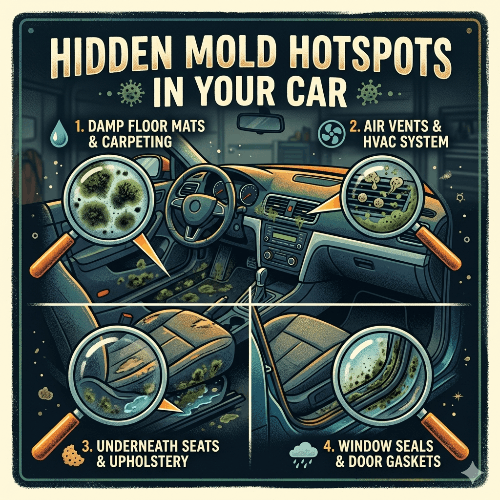
When mold or bacteria colonize moist surfaces — carpet, seat foam, door panels, HVAC evaporator cores — they break down the organic material (cellulose, proteins, fats) for energy and growth. This metabolic process releases volatile organic compounds as a byproduct. The most common MVOC smells are:
| MVOC Type | Source (Mold/Bacteria) | Smell Description | Health Relevance |
|---|---|---|---|
| Geosmin | Actinobacteria, some molds | Earthy, petrichor (rain smell) | Odor trigger; may cause irritation at high concentrations |
| 2-Methylisoborneol (MIB) | Cyanobacteria, actinobacteria | Musty, moldy | Respiratory irritant; linked to sinus inflammation |
| 1-Octen-3-ol | Common molds (Fusarium, Aspergillus) | Mushroom, organic decay | Volatile irritant; associated with airway discomfort |
| Dimethyl Disulfide (DMDS) | Anaerobic bacteria in standing water | Rotten egg, sulfurous | Strong irritant; indicates bacterial overgrowth |
| Dimethyl Trisulfide (DMTS) | Anaerobic bacterial zones | Rotting garbage, fecal | Severe irritant; sign of advanced contamination |
| Trimethylamine (TMA) | Bacteria breaking down proteins/keratin | Fish, ammonia-like | Mucosal irritant; may trigger headaches |
How Mold Creates MVOCs: The Metabolic Process
The Mold Life Cycle in a Vehicle
Mold doesn't simply sit dormant on a surface — it's metabolically active, feeding on organic substrates in your vehicle interior and continuously releasing chemical byproducts.
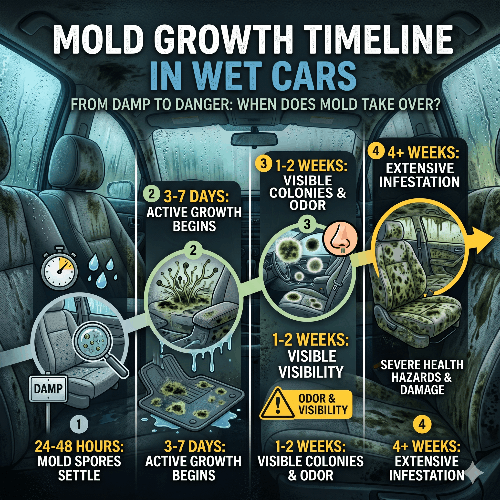
- Spore germination (hours): Mold spores, always present in ambient air, land on a wet surface. If moisture and food source are present, germination begins.
- Mycelium growth (1–3 days): The fungus extends threads (hyphae) into the substrate, breaking down materials enzymatically and beginning to colonize deeper layers.
- MVOC production (24–48 hours into growth): As metabolism ramps up, the mold releases volatile compounds — initially subtle, but detectable to sensitive noses as "musty" odor.
- Reproductive phase (5–14 days): The mold produces spores and toxins, while MVOC output peaks. This is when the smell becomes overpowering and health effects intensify.
- Toxin production: Many common vehicle molds (Aspergillus, Fusarium, Stachybotrys) produce secondary metabolites including mycotoxins alongside MVOCs. The two aren't the same — mycotoxins are toxins; MVOCs are odor/irritant compounds — but they're produced by the same organism and indicate active mold metabolism.
How Bacteria Produce MVOCs: A Different Chemistry
Bacterial MVOC Sources in Vehicles
Bacteria create MVOCs through different metabolic pathways than mold, often in anaerobic (oxygen-poor) or microaerophilic conditions — exactly what exists in standing water, wet floor insulation, or drainage blockages in vehicle cabins.
| Bacterial Condition | Location in Vehicle | MVOC Signature Smell | Health Risk Level |
|---|---|---|---|
| Anaerobic zones (no oxygen) | Trapped water behind door panels, under flooring, blocked HVAC drains | Rotten egg, sulfur, fecal | HIGH — strong irritant; indicates advanced bacterial growth |
| Aerobic biofilms | HVAC ducts, evaporator coils, wet carpet | Organic, fishy, ammonia-like | MEDIUM — respiratory irritant; persistent if untreated |
| Thermophilic (heat-loving) bacteria | Around heated HVAC systems and warm floor areas with moisture | Musty with chemical/plastic overtones | MEDIUM-HIGH — linked to hypersensitivity reactions |
| Pseudomonas aeruginosa (biofilm) | Stagnant A/C condensate drains, evaporator trays | Sweet, fruity, or musty-organic blend | HIGH — opportunistic pathogen; respiratory risk |
Bacterial MVOCs often smell worse than mold-derived compounds because bacteria in oxygen-free or low-oxygen environments (where sulfur compounds dominate) produce powerful sulfide compounds like dimethyl disulfide and dimethyl trisulfide. These are the chemicals responsible for the "rotten egg" or "garbage truck" smells that make vehicle interiors nearly unlivable.
The Mold-Bacteria Tandem
In many contaminated vehicles, mold and bacteria don't exist alone — they exist in a polymicrobial biofilm. The mold creates a sticky extracellular matrix that traps moisture and organic material, creating ideal conditions for bacteria to flourish. The bacteria then produce their own MVOCs, and the combined chemical profile becomes severe. This tandem contamination is why simple odor treatments or spot cleaning fail — you're not treating a mold problem or a bacteria problem; you're treating both simultaneously.
Health Effects of MVOC Exposure: Beyond the Bad Smell
Short-Term Health Effects
Most drivers notice these symptoms immediately when entering a moldy or bacterial-contaminated vehicle:
- Nasal congestion and sinus irritation — MVOCs are volatile irritants that trigger mucous membrane inflammation within minutes of exposure
- Eye irritation and watering — compounds like 1-octen-3-ol are known ocular irritants
- Coughing and throat clearing — MVOC inhalation triggers airway defensive responses
- Headaches — linked to airway irritation and reduced oxygen intake in response to constricted breathing
- Fatigue and mental fog — prolonged MVOC exposure impairs cognitive function (documented in office buildings with mold/moisture problems)
- Asthma exacerbation — children and adults with asthma show measurably increased bronchial hyperresponsiveness after MVOC exposure
Long-Term Health Effects
For those who drive contaminated vehicles regularly (commuters, commercial drivers, families using a moldy vehicle daily), prolonged MVOC exposure creates cumulative risks:
- Chronic sinus inflammation — repeated irritation can lead to chronic rhinosinusitis and recurrent infections
- Persistent respiratory irritation — airway sensitivity can persist long after exposure ends
- Immune sensitization — repeated MVOC exposure can increase susceptibility to other respiratory triggers
- Mycotoxin co-exposure — mold-derived MVOCs often accompany mycotoxin production. While mycotoxins and MVOCs are distinct, co-exposure amplifies health risk for immunocompromised individuals
- Aggravation of existing conditions — individuals with allergies, asthma, or chronic obstructive pulmonary disease (COPD) show accelerated symptom progression with regular MVOC exposure
Detecting MVOCs in Your Vehicle: The Warning Signs
Sensory Indicators
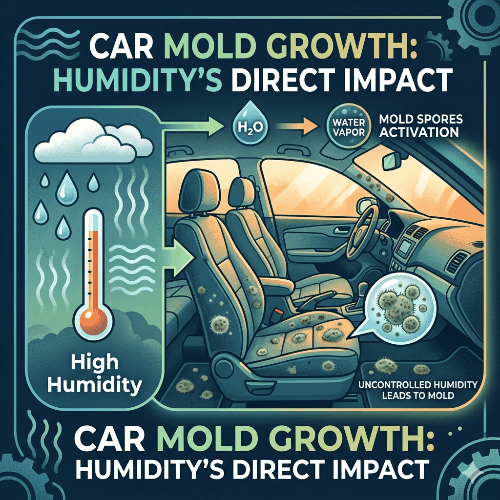
Pro tip: Use a moisture meter and hygrometer — Place a hygrometer in your vehicle's cabin. If interior humidity consistently reads above 55–60%, you have a moisture problem that's already feeding MVOC production. EPA guidance for enclosed spaces recommends keeping relative humidity below 60%, ideally between 30 and 50%. A moisture meter on carpet, door panels, and seat bases reveals hidden wet zones where MVOCs are being actively produced.
The Hidden Locations Where MVOCs Are Produced
Highest-Risk MVOC Hotspots in Vehicles
MVOC Remediation: Professional vs. DIY — Why It Matters
Why Surface Cleaning and Odor Masking Fail
The persistent myth: "I'll just spray Febreze" or "ozone treatment will kill the smell." Here's why these fail:
- Febreze and air fresheners: They mask the odor with a stronger smell but don't eliminate the MVOC source. The mold or bacteria continues producing MVOCs, and you're inhaling both the original compounds and the fragrance.
- Ozone treatments: Ozone can oxidize some VOCs, but it doesn't remove the mold or bacteria. It also can't penetrate porous materials (foam, carpet, insulation) where MVOCs are being actively produced. After ozone treatment fades, the original source resumes producing MVOCs within hours.
- Bleach or hydrogen peroxide spray: These damage upholstery and don't reach the root — mold and bacteria deeply embedded in foam or insulation. Surface bleaching kills visible mold but leaves the subsurface source intact.
- Air purifiers: They trap airborne particles and some VOCs, but they run only while the vehicle is parked. A running air purifier can't manage MVOC concentrations faster than a wet mold colony produces them. Once you drive with the windows closed, MVOC accumulation resumes.
Effective MVOC remediation requires finding and removing the source, treating contaminated materials, and drying the structure — not masking the symptom.
Professional MVOC Remediation: The Standard Process
This is the approach used by professionals adhering to ANSI/IICRC S520 remediation standards:
Moisture meters, thermal imaging, and HVAC system inspection locate every wet zone. For MVOC problems, the source is usually the HVAC system (evaporator, drain, ducts) or standing water in concealed cavities. The entire scope of contamination must be identified before treatment — treating one area while a secondary source remains guarantees rapid regrowth.
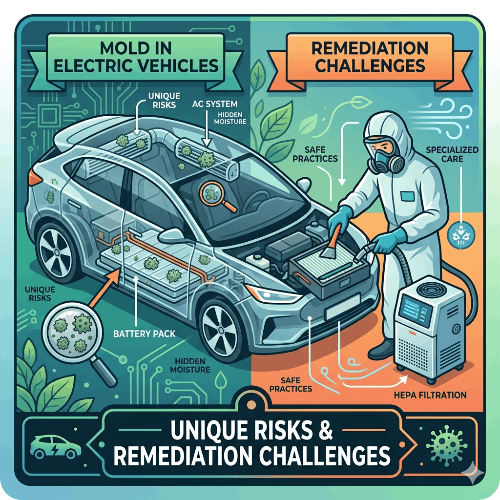
HEPA air scrubbers are placed inside the vehicle to capture disturbed spores and MVOC particulates during the remediation process. Full PPE (N95/P100 respirators, gloves, protective clothing) is worn by technicians — MVOC inhalation exposure is minimized at the source.
If the evaporator, cabin air filter, or ductwork is contaminated, these are not "cleaned in place" — they're treated or replaced. A professional HVAC purge using non-conductive methods (never harsh liquid cleaners near electrical components) removes biofilm, fungal growth, and bacterial colonies. The cabin air filter is replaced with a fresh MERV 13 unit. Condensate drain lines are cleared of blockages.
Carpet, seat foam, and padding with mold or bacterial growth cannot be safely "cleaned" — they must be removed and replaced. Once mold or bacteria colonizes porous foam, it extends deep into the material where surface treatments can't reach. Removal is the only way to eliminate the source.
ClO₂ is a non-conductive, non-corrosive gas that penetrates porous materials (foam, insulation, ductwork) and oxidizes mold, bacteria, and mycotoxins at the molecular level. It reaches areas surface sprays can't — under carpeting, deep within foam, in HVAC cavities. ClO₂ is ideal for EV and modern vehicle treatment because it won't damage electronics or high-voltage systems (unlike harsher chemical alternatives).
Using moisture meters, technicians confirm that insulation, carpet padding, and structural materials reach moisture content levels below what mold and bacteria need to survive (below 20% moisture content). Targeted drying with air movers and dehumidifiers brings wet zones down to safe levels — typically a multi-day process.
After contamination is removed and the interior is dry, a mold-inhibitor encapsulant can be applied to remaining materials as a final protective layer — preventing future spore settlement and biofilm formation. This is applied only after the contaminated source is gone; it's never a substitute for removal.
Post-remediation verification includes HVAC ductwork inspection, air quality testing (MVOC and spore count), and surface testing to confirm mold and bacterial levels are below pre-remediation baselines. This separates real remediation from cosmetic cleaning — and provides documentation for warranty and resale value.
Prevention: Stopping MVOC Production Before It Starts
Prevention is always cheaper than remediation. A few consistent habits dramatically reduce MVOC risk:
- Keep the interior dry: Remove wet items (umbrellas, gym bags, damp clothing) immediately after entering the vehicle. Moisture is the fuel for mold and bacterial MVOC production.
- Run HVAC on fresh-air mode at the end of each drive: The last 2–3 minutes of your drive, switch to fresh-air mode (not recirculate) and run the fan on medium-high. This dries the evaporator core and ductwork, preventing moisture accumulation that feeds MVOC production.
- Replace cabin air filters on schedule (or sooner in humid climates): A clogged cabin air filter traps moisture and becomes a biofilm incubator. Replace every 12,000–15,000 miles in normal climates; every 8,000–10,000 miles in humid or dusty conditions. Use MERV 13 filters, which capture smaller particles and are less likely to clog with biological material.
- Inspect and clear A/C condensate drains annually: A backed-up drain creates stagnant water — the ideal environment for anaerobic bacterial MVOC production (rotten egg smells). A simple flush or compressed-air blow-through prevents blockages and keeps the condensate pan dry.
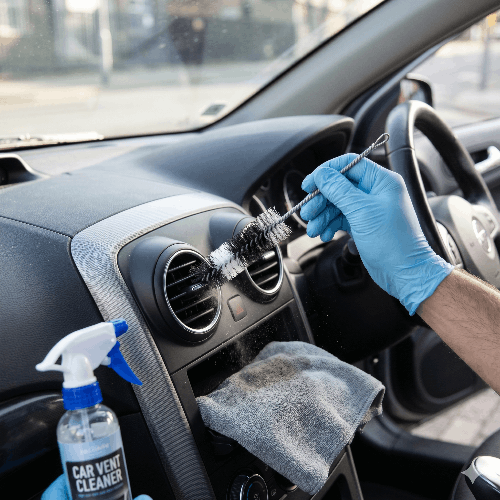
- Have HVAC professionally treated once or twice yearly: Rather than relying on store-bought "HVAC cleaner" sprays (which can damage components or leave residue), a professional treatment uses safe, non-conductive methods to prevent biofilm and mold colonization on evaporator coils. This is especially important in humid climates.
- Crack a window when parked (weather permitting): Even a small opening allows air circulation and lets interior humidity equalize with ambient conditions, slowing mold and bacterial growth. This is most effective during warm months when parking in covered areas.
- Run dehumidifiers in humid garages: If your vehicle is garaged in a humid climate (Southeast US, Gulf Coast, Pacific Northwest), a standalone dehumidifier in the garage reduces ambient humidity that the HVAC system would otherwise pull into the cabin.
- Inspect door seals and frunk/trunk drains quarterly: Water intrusion is one of the earliest signs of seal failure or drainage problems. Catch these issues early before water accumulates in hidden cavities.
Frequently Asked Questions About MVOCs in Vehicles
MVOCs in Vehicles: The Bottom Line
Microbial volatile organic compounds — released by mold and bacteria in your vehicle's hidden cavities — are more than a bad smell. They're chemical irritants linked to respiratory symptoms, sinus problems, asthma exacerbation, and long-term health effects that vehicle owners often don't connect to their cars.
The sealed-cabin design that defines modern vehicles — from electric cars to contemporary gas models — creates ideal conditions for rapid MVOC production: trapped moisture, limited air exchange, and plenty of organic material for mold and bacteria to feed on. Prevention through moisture control and regular HVAC maintenance is far cheaper than remediation. But if you're already noticing musty smells, respiratory symptoms in your vehicle, or signs of moisture, early professional intervention stops the problem before contamination spreads and health effects worsen.
Whether it's a musty evaporator core, bacterial overgrowth in standing water, or a combination of both, Car Mold Guys assess vehicles safely around high-voltage systems, locate the MVOC source using moisture mapping, and eliminate it with chlorine dioxide treatment backed by ANSI/IICRC S520 protocols. 100% mobile across Georgia, South Carolina, North Carolina, Tennessee, Florida, and Alabama — covered by a 90-day MVOC warranty.
Noticing Musty Smells or MVOC Odors in Your Vehicle?
Don't let mold and bacterial MVOC production damage your health or your vehicle. A professional assessment locates the source — HVAC contamination, moisture intrusion, or hidden biofilms — and eliminates it completely.
Related Articles on Vehicle Health & Mold Remediation
- How to Identify Mold in Electric Vehicles: Hidden Hotspots and Warning Signs
- Why Chlorine Dioxide Is the Gold Standard for Vehicle Mold Remediation
- HVAC System Mold and Health: What Vehicle Owners Need to Know
- Moisture Control in Vehicles: Prevention Strategies for Every Climate
- Mycotoxins vs. MVOCs: Understanding the Difference and Health Impacts