
Is Car Mold a Common Problem?
Short answer: yes — far more common than most drivers realize. Mold doesn't need much of an invitation. All it requires is moisture, warmth, and an organic surface to feed on, and the interior of your car offers all three in abundance. Fabric seats, carpet padding, foam headliners, and rubber seals are practically a buffet for mold spores. The good news is that common doesn't mean inevitable — once you understand what drives it, it's largely preventable.
What Starts Car Mold?
Mold spores are already floating in the air everywhere — harmless until they find moisture. In a car, these are the usual triggers that give them what they need:
|
Spills & forgotten moisture A spilled coffee, a wet umbrella, or a soaked gym bag soaks deep into padding and foam — where it doesn't dry and you can't see it. |
Humidity & condensation In the humid Southeast, moisture cycling onto cool interior surfaces can push the cabin into the danger zone without a single spill. |
|
Flooding & storm damage Floodwater penetrates every interior layer; without rapid professional drying, colonies entrench within days. |
Improper cleaning Shampooed seats or steam-cleaned carpets that never fully dry become a prime environment for spores to take hold. |
The big one: water leaks
Faulty door seals, cracked windshields, blocked sunroof drains, and worn weatherstripping let water in quietly — a slow leak can saturate flooring for weeks before any mold appears. Nearly every serious car-mold case traces back to a leak, which is exactly why finding and fixing the source is always step one.
What Does Car Mold Look Like — and Smell Like?
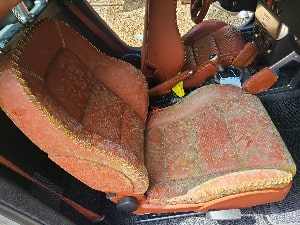
Mold in a vehicle often shows up as fuzzy or powdery patches in black, green, gray, or white — on seat seams, under floor mats, on the headliner, around door sills, or beneath the seats where spills gather and air barely moves. But it doesn't always announce itself visually.
The earliest sign is usually smell
That damp, earthy, musty odor many drivers shrug off as "old car smell" is actually microbial volatile organic compounds (MVOCs) released by active mold. If your car smells musty, take it seriously even if you can't see a thing — and know that masking it with air freshener won't fix the cause.
The Real Health Risks of Car Mold
This is where car mold shifts from an inconvenience to a genuine safety issue. The EPA links mold exposure to a consistent set of effects — and a car makes them worse, because the HVAC system circulates spores directly onto occupants every time you run the heat or A/C. Watch for:
|
Nasal & sinus congestion Stuffiness and recurring sinus irritation, often worse during a drive. |
Eye & skin irritation Itchy or watery eyes and skin reactions in the enclosed cabin. |
|
Coughing & wheezing Airway irritation from spores suspended in recirculated cabin air. |
Worsened asthma Asthma symptoms triggered or intensified by ongoing exposure. |
In higher-risk individuals
People with asthma, mold allergies, or weakened immune systems — along with children and the elderly — react more strongly, and should treat even brief exposure in a closed cabin seriously. (More on why car mold is worth taking seriously.)
Does Car Mold Hurt Your Vehicle's Value?
Absolutely. A vehicle with a visible or documented mold problem takes a real hit at resale. Mold permanently stains fabric, degrades foam padding, and can corrode metal components if left long enough — and nothing kills a sale faster than a musty-smelling cabin, since interior condition is one of the first things buyers judge. Treating it early isn't only about health; it's a smart financial decision.
How Car Mold Actually Gets Treated
Here's the honest version most "car mold" articles skip: mold isn't a cleaning problem, it's a remediation problem. A wipe-down handles what you can see; the colony lives in what you can't. Here's how it really gets addressed:
Act fast. The longer a colony grows, the deeper it penetrates and the costlier it is to undo. Speed is everything.
Inspect the scope. Pull the mats, check under seats and in the trunk, and run a flashlight along seams and door seals to find how far it reaches.
Know that surface treatment only buys time. Spraying or wiping won't reach mold rooted in seat foam, carpet padding, and HVAC ducts — which is why detailed or DIY-treated cars almost always relapse.
Dry it at the substrate. Surface drying isn't enough — padding stays soaked underneath, so trim and carpet have to be pulled back to dry the foam down to the floor pan.
Get professional remediation. The real fix repairs the leak, removes and replaces contaminated padding, treats the interior with chlorine dioxide — not ozone, which degrades rubber seals — purges the HVAC system, and installs a fresh MERV 13 cabin filter. That's the work Car Mold Guys does, to the ANSI/IICRC S520 standard.
How to Prevent Car Mold
Prevention is always easier than remediation. A few consistent habits go a long way:
- Address spills immediately — blot, then pull moisture out with a wet/dry vac and aim a fan at the spot.
- Check your weather seals annually — shut a dollar bill in the door; if it slides out easily, the seal is worn and letting moisture in.
- Use moisture absorbers — DampRid or reusable silica canisters keep cabin humidity down, especially in humid climates.
- Run your A/C regularly — it actively dehumidifies the cabin, even in mild weather.
- Don't leave wet items in the car — towels, rain-soaked jackets, and damp gear are classic triggers.
- Have your HVAC inspected — the A/C evaporator coil is a known mold growth point worth checking.
The Bottom Line: Don't Wait on Car Mold
Car mold is common, but it isn't inevitable — and it's never something to put off. The longer a colony grows, the deeper it goes, the harder it is to treat, and the more it costs you in both interior damage and health. Whether it's a faint musty odor or a full infestation after a flood, acting quickly is always the right move. Our FAQ and our guide to the types of mold found in cars are good next reads.
Don't Allow Mold to Make Your Car Its Home
If you've spotted mold or caught that musty smell, the specialists at Car Mold Guys find the leak, remove the mold at its source, and treat with chlorine dioxide — mobile to your door, backed by a 90-day warranty across GA, SC, NC, TN, FL, and AL.
Sources: EPA — Mold Course · EPA — Mold, Moisture, and Your Home