
How We Professionally Purge Your Car's Entire Ventilation System
If you've ever climbed into your car and been hit by a musty, mildewy smell the moment you flip on the A/C, you already know the problem. That smell isn't coming from your seats. It isn't coming from your floor mats. It's coming from deep inside your car's ventilation system, and no amount of air freshener is going to fix it.
At Car Mold Guys, we specialize in automotive mold remediation, and one of the most critical — and most overlooked — parts of the job is fully purging the ventilation system from end to end. That means the ducting, the dash vents, the cabin air filter compartment, and every hidden channel in between. Here's exactly how we do it, why each step matters, and why a professional approach delivers results that DIY products simply can't match.
Why Your Car's Ventilation System Is a Mold Magnet
Your vehicle's HVAC system is designed to move air — but it's also designed to collect moisture. Every time you run the air conditioner, condensation forms on the evaporator coil. That moisture drips into a drain pan, travels through a drain tube, and exits the vehicle. When that drain is slow or clogged, or when humidity is high (hello, Georgia summers), standing moisture inside the system creates the perfect environment for mold to colonize.
Add in organic debris — pollen, dust, dead insects, leaves — and microbial growth doesn't just survive in your ductwork. It thrives. EPA guidance is direct on both points: damp material needs drying within 24 to 48 hours to avoid mold growth, and poorly draining condensate pans inside air handling units are a known site of hidden growth. Your car's HVAC system gives mold exactly that opportunity, over and over, every time you park.
The result? Microbial volatile organic compounds — the gases produced by actively growing mold — get blown directly into the cabin every time your fan runs. That's what you're smelling. That's what you're breathing.
“The evaporator coil is the single most contaminated component in most vehicles — and without treatment that reaches it, it keeps re-seeding the entire system after any surface-level cleaning.”
The Professional Ventilation Purge: A Three-Phase Approach
There's no single magic product that solves this. Professional remediation is a process, not a spray. Here's how we approach a full ventilation purge, aligned to the ANSI/IICRC S520 standard for professional mold remediation:
|
1
|
Chlorine dioxide treatment
We treat the entire ventilation system with chlorine dioxide, a gas-phase oxidizer. This is fundamentally different from the "bomb" canisters sold at auto parts stores, which release a burst of fragrance and minimal active ingredient. Because chlorine dioxide works as a gas rather than a liquid or aerosol, it penetrates duct walls, evaporator coil fins, and the plenum chamber behind your dashboard — places no brush or spray bottle ever reaches. We set the HVAC system to recirculation at max fan speed and introduce the treatment through the cabin air filter intake, so the system pulls it through every channel it would normally push conditioned air through. It dwells, makes contact with biofilm and mold colonies, and breaks down the cellular structure of the contamination — along with the mycotoxins a surface product leaves behind entirely. |
|
2
|
Compressed air purge
Once the treatment has had proper dwell time, we move into a high-pressure compressed air purge of all accessible ducting and vent openings. This is where the mechanical disruption happens. Using a blow gun at regulated pressure, we work methodically through every vent — driver's side, passenger side, rear, and floor — to dislodge loosened debris, dead spores, and organic buildup and force it out of the ducting where it can be captured. This step requires care. Blowing air improperly can push contamination deeper into the system or drive debris into the blower motor housing. Our technicians work directionally, always pushing material toward accessible exits. We purge the cabin air filter compartment at this stage too — the housing is routinely skipped during standard filter changes, and it often holds a layer of compacted debris that a new filter alone won't solve. |
|
3
|
Brush agitation of vents and accessible ducts
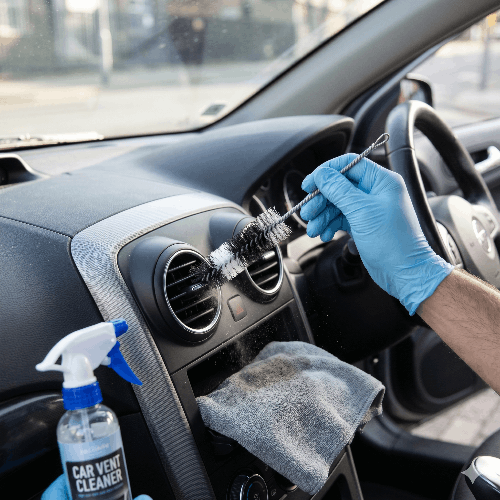
The final mechanical phase is manual brush agitation using long-handled detail brushes sized for duct openings and vent louvers. This addresses what treatment and compressed air can't fully reach on their own: surface biofilm and debris adhered to duct walls, vent grilles, and the louver mechanisms inside each outlet. We use stiff-bristle brushes for duct interior walls and softer detailing brushes for the louvers themselves. Louver vanes are notorious for collecting a thick layer of dust and mold debris on their forward-facing edges — buildup that blows straight back into the cabin the moment you turn on the fan. Brush agitation followed by vacuum extraction removes it completely, and a second lighter treatment pass recoats every newly exposed surface. |
The Cabin Air Filter: Don't Skip This Step
A contaminated cabin air filter doesn't just fail to protect you — it actively makes the problem worse. A filter loaded with spores and organic material becomes a continuous source of contamination, re-inoculating the system every time air flows through it.
We always install a fresh MERV 13 cabin filter as part of a full ventilation remediation, and we treat the filter housing as described above. MERV 13 is the right specification for a vehicle: it captures the fine particulate that matters without choking the airflow your HVAC system was engineered around. True HEPA media belongs in a vacuum or an air scrubber, not in a cabin filter slot — the pressure drop is more than an automotive blower is built to overcome.
Why Professional Remediation Beats DIY Every Time
We understand the appeal of a $15 can from the auto parts store. Here's the honest breakdown of why those products consistently fail:
Aerosol bombs cannot reach the evaporator coil, the plenum, or the interior duct walls. They treat the surfaces the air touches on exit — not the source of the contamination.
No product alone removes an established colony. Physical agitation — brushing, air purging, extraction — is irreplaceable. A treatment without mechanical removal coats over the problem.
A can doesn't find the clogged drain, the failing seal, or the water leak feeding the problem. Untreated, the moisture source brings the mold straight back.
Ozone machines — the detailer's usual answer — are surface deodorizers that degrade rubber seals and leave contamination in porous material untouched.
EPA guidance states plainly that no antimicrobial products or biocides are approved for use on lined ductwork, and that duct insulation which becomes wet or moldy should be removed and replaced rather than cleaned, because it cannot be cleaned effectively. That's the clearest possible verdict on the consumer spray approach — and the reason our process combines gas treatment with physical removal rather than relying on a product alone.
What to Expect After a Full Ventilation Purge
Most customers notice a dramatic difference immediately. The musty odor that greeted them every time they started the car is gone. Airflow through the vents often improves as well, since debris buildup in ductwork and on the evaporator coil restricts airflow over time.
Within the first 24 to 48 hours, any residual treatment smell dissipates completely, leaving the cabin neutral and clean. We recommend leaving windows cracked for the first day and running the HVAC on fresh-air mode rather than recirculation to help the system fully flush.
Prolonged mold exposure is associated by the National Institute of Environmental Health Sciences with respiratory irritation, coughing, wheezing, and aggravated asthma — which is why we finish with air-quality verification rather than a smell test. If it isn't verified, it isn't finished.
One important caveat: a ventilation purge addresses the ventilation system. If carpet padding, seat foam, or headliner backing is also contaminated, that material has to come out and be replaced — EPA guidance reaches the same conclusion for any porous material that has stayed wet. For vehicles with severe contamination or ongoing moisture intrusion, a follow-up treatment at 30 days may be recommended. Not sure which you're dealing with? Start here.
Ready to breathe clean air in your car again?
The specialists at Car Mold Guys purge the entire ventilation system — chlorine dioxide treatment, compressed air, and brush agitation — then install a fresh MERV 13 filter and verify the air quality before we leave. Mobile to your door across Georgia, South Carolina, North Carolina, Tennessee, Florida, and Alabama, backed by a 90-day warranty.