Hidden Mold Hotspots in Your Car

Hidden Mold Hotspots in Your Car

Car Health & Safety Guide

Hidden Mold Hotspots in Your Car

The places you'd never think to check — and why finding them early could protect your health and your vehicle.

Mold Prevention Car Maintenance Air Quality Indoor Health

You wipe down the dashboard. You vacuum the floor mats. You even hit the car wash every couple of weeks. So why does your car still smell faintly musty when the air conditioning kicks on — or on a rainy Monday when you've just closed the door?

The answer is almost certainly mold. And not the kind you can see. Car mold is a stealth problem, thriving in moisture-rich environments tucked deep inside your vehicle's architecture — places no cleaning cloth has ever touched. Left unaddressed, it degrades air quality, triggers allergies, and can cause permanent damage to upholstery, carpet backing, and HVAC components.

This guide maps every hidden mold hotspot in your car, explains why each is vulnerable, and tells you exactly what to do about it.

70% of mold growth begins within 24–48 hours of moisture exposure
400+ mold species have been identified in vehicle interiors
$1,500+ average professional remediation cost for severe car mold cases

Why Cars Are Prime Mold Territory

Your car is essentially a sealed, insulated box that regularly encounters rain, humidity, spilled drinks, damp clothing, and wet shoes. Unlike your home, it has limited airflow when parked, and most of its interior materials — carpet backing, foam seat cushions, headliner fabric — are highly porous and moisture-retentive.

Add to that the fact that most drivers never inspect beneath their seats, inside their HVAC ducts, or under their floor mats, and you have the perfect conditions for a slow-growing mold colony that can go undetected for months — sometimes years.

"Mold doesn't need a flood to thrive in your car. A forgotten wet umbrella, a cracked door seal after a rainstorm, or a persistently damp air conditioning system is all it takes."

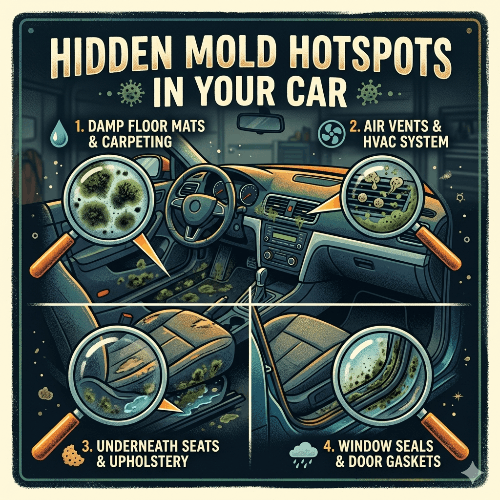
The 8 Hidden Mold Hotspots in Your Car

Here are the locations most drivers never check — ranked from most commonly overlooked to most structurally damaging:

â„ï¸

1. The HVAC System & Air Vents

The evaporator coil inside your climate control system collects condensation every time you run the AC. That persistent moisture becomes a breeding ground for mold, which then gets blown directly into your cabin air every time you turn on the fan.

🪑

2. Under the Front Seats

Food crumbs, spilled drinks, and tracked-in rainwater pool in the recessed tracks beneath front seats. The low light and poor airflow make this one of the most mold-friendly spots in any vehicle.

🧱

3. The Carpet Backing & Padding

The visible carpet may look fine, but the foam padding beneath it is a moisture sponge. Once wet, it rarely dries completely — especially under floor mats that trap moisture against it indefinitely.

🚗

4. The Trunk & Spare Tire Well

Trunk seals degrade over time, allowing water intrusion during heavy rain. The spare tire well is a basin by design — any water that enters it has nowhere to go. Mold often grows invisibly here for years.

â˜ï¸

5. The Headliner

The fabric ceiling of your car is glued to a foam backing. When sunroof drains clog or door seals fail, moisture wicks into this backing and mold spreads silently overhead, sometimes visible only as subtle staining or sagging fabric.

🚪

6. Door Panels & Window Seals

Condensation inside door panels is extremely common, particularly in climates with significant temperature swings. Water can pool in the lower sections of door panels for weeks before becoming noticeable.

💺

7. Seat Foam & Track Channels

Cloth and leather seats alike can harbor mold in their internal foam, especially if a spill was never fully addressed. The seat adjustment tracks alongside them collect debris and moisture in tight, poorly-ventilated channels.

🔧

8. The Cabin Air Filter Housing

Your cabin air filter is designed to catch particulates — but a clogged or wet filter becomes a mold host itself. The housing around it, often damp from condensation, is rarely inspected and even more rarely cleaned.

âš ï¸ Health Warning: Symptoms You Shouldn't Ignore

Car mold exposure is linked to a range of health symptoms that many people mistakenly attribute to seasonal allergies or fatigue. If you or your passengers regularly experience any of the following while in your vehicle, mold may be the cause:

Sneezing, coughing, or watery eyes specifically when in the car · Headaches that resolve after leaving the vehicle · Persistent musty or earthy smell from the vents · Unexplained worsening of asthma symptoms during or after car trips.

Children, elderly passengers, and anyone with compromised immune function are especially vulnerable to mycotoxins produced by certain mold species.

✦

How to Inspect Your Car for Hidden Mold

A proper mold inspection doesn't require professional equipment. What it requires is thoroughness and a willingness to get into awkward spaces. Set aside about 30 minutes and work through the following process on a dry, well-lit day.

Start with Your Nose

Before you look at anything, get in the car, close all doors, and turn the AC to recirculation mode for two minutes. A musty, earthy, or locker-room odor is your first and most reliable indicator of active mold growth somewhere in the HVAC system or interior. Note whether the smell intensifies from specific vents.

Work From the Floor Up

Remove all floor mats and inspect the carpet beneath them. Press firmly with your hand — does it feel damp? Is the carpet backing darker than the rest? Lift the edges near the door sills, where water most commonly enters. Use a flashlight under both front seats and along the seat track channels.

Check the Trunk Thoroughly

Remove everything from the trunk, including the spare tire cover. Look for watermarks, staining, or any black, green, or white fuzzy growth in the corners and along the seams. Press on the trunk carpet — retained moisture will compress differently than dry carpet.

Inspect the Cabin Air Filter

Your owner's manual will tell you exactly where the cabin air filter is located — usually behind the glove box or under the dashboard. Pull it out and inspect it. A filter that looks dark, damp, or has visible spotting should be replaced immediately, and the housing should be wiped down with a diluted white vinegar solution.

✦

Eliminating Car Mold: What Actually Works

Once you've identified a problem area, your approach depends on the severity and location of the growth. Here's what works — and what doesn't.

  • HEPA vacuuming first, always. Before applying any treatment, vacuum the affected area thoroughly with a HEPA-filter vacuum. This prevents loose spores from becoming airborne during cleaning.
  • White vinegar for surface mold. Undiluted white vinegar (5% acidity or higher) is one of the most effective non-toxic mold killers available and won't damage most automotive fabrics. Apply, let sit for 10 minutes, then blot dry.
  • Enzyme-based cleaners for organic debris. For mold feeding on food residue or organic material, enzyme cleaners break down the food source and the mold simultaneously. Products designed for pet odor elimination often work well here.
  • HVAC disinfectant spray for the vents. Automotive HVAC disinfectants (available at any auto parts store) are designed to be sprayed directly into the intake vents while the AC runs on fresh air mode. They reach the evaporator coil and treat the source of vent-based mold.
  • Replace, don't clean, saturated padding. If the foam padding beneath your carpet has been wet for more than a few days, cleaning is rarely sufficient. The padding retains moisture that surface cleaning can't reach. Replacement is the only reliable fix.
  • Silica gel desiccants for prevention. After remediation, place silica gel packets under seats and in the trunk to absorb ambient moisture and prevent recurrence — especially during humid seasons.
  • Run the AC on fresh air (not recirculation) periodically. Running fresh-air mode dries out the evaporator core and vents, significantly reducing the moisture that enables mold growth in the HVAC system.

When to Call a Professional

DIY remediation works well for surface-level or early-stage mold. But there are situations where professional help is the right call. If mold has penetrated seat foam throughout the interior, if the smell persists after thorough treatment, or if you notice structural discoloration of the headliner, door panels, or carpet backing despite multiple cleaning attempts — you're dealing with established mold colonization that requires professional extraction, ozone treatment, or component replacement.

Professional auto detailers who specialize in mold remediation use ozone generators and foggers to reach every interior cavity. While not cheap, this approach is far less expensive than the health costs of prolonged exposure or the resale value damage from an untreated mold problem.

✦

Prevention: The Cheapest Mold Remedy of All

Every mold problem starts with moisture, and moisture in your car almost always has a preventable source. Building these habits into your routine will keep your car's interior dry and mold-free year-round:

Never leave wet items in a closed car. Damp towels, wet umbrellas, rain-soaked jackets — these are among the most common sources of car mold. If wet items must travel with you, place them in a waterproof bag or open the windows briefly after parking to allow the moisture to disperse.

Inspect door and trunk seals annually. Rubber seals degrade, crack, and compress over time. A simple test — close a dollar bill in the door and try to pull it out — tells you whether the seal is still providing adequate compression. Replace failing seals before they allow water intrusion.

Replace the cabin air filter every 12,000–15,000 miles. Most drivers stretch this interval far longer than recommended. A clogged filter restricts airflow and retains moisture, which together create ideal mold conditions just upstream of your air vents.

Address spills immediately and completely. Surface cleanup is not enough. Any spill that reaches the carpet should be blotted with clean towels, treated with a diluted vinegar solution, and allowed to air dry completely — with the doors open if possible.

Found Mold in Your Car? Don't Wait.

Mold colonies double in size rapidly once established. The sooner you address it, the less damage — and the lower the remediation cost. Use this guide as your starting point, and don't hesitate to consult a professional when the problem is beyond surface level.

Book a Professional Mold Inspection →
Car Mold Growth and Humidity

Car Mold Growth and Humidity

Automotive Health & Maintenance

How Humidity Levels Directly Trigger Car Mold Growth

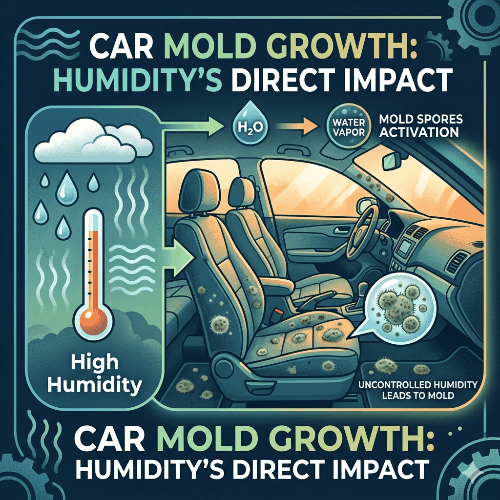
You park your car. A week passes. You open the door and catch that unmistakable musty smell — the kind that clings to fabric and refuses to leave. Humidity is the silent culprit, and it doesn't need a flood to do its damage.

Mold doesn't appear by accident. It follows a predictable biological trigger: moisture. Specifically, it's the relative humidity inside your car's cabin that determines whether mold spores — always present in the air — remain dormant or burst into active, spreading colonies. Understanding this relationship is the single most important thing you can do to protect your vehicle's interior.

60%Relative humidity threshold where mold activation begins
24–48hTime for visible mold colonies to form in warm, humid conditions
77°F+Temperature that accelerates mold growth alongside humidity
$1,500+Average cost of professional mold remediation for a vehicle

What exactly is relative humidity — and why does your car trap it?

Relative humidity (RH) measures how much water vapor is in the air compared to the maximum it can hold at a given temperature. A car cabin is a sealed micro-environment: it traps moisture from wet shoes, damp clothing, breathing passengers, spilled drinks, and rain that sneaks in through imperfect door seals. Unlike your home, a car has very little natural air exchange when parked.

On a humid summer day in cities like Atlanta, Miami, or Houston, the ambient RH can already sit at 75–90%. Inside a closed, dark, stationary car, that moisture has nowhere to go. Seats, carpet padding, and headliner foam absorb it. The result is a microclimate that is often more humid than the outside air — the ideal nursery for mold.

A car interior left closed in humid conditions for 48 hours can accumulate enough moisture in its soft materials to sustain mold growth for weeks — even after drying out.

The humidity-to-mold activation spectrum

Not all humidity levels pose the same risk. Here's how relative humidity maps directly to mold danger inside a vehicle:

Relative Humidity vs. Mold Risk — Car Interior
Below 50%
Safe zone — mold spores remain dormant. Ideal for car storage.
50–60%
Caution zone — elevated risk in warm temperatures above 70°F. Monitor closely.
60–70%
High risk — mold spores activate. Musty odors begin within 48 hours if sustained.
70–85%
Severe risk — rapid colony formation. Visible mold appears on seats and carpet.
Above 85%
Critical — mold doubles every few hours. Structural materials begin to degrade.

The biological mechanics: how humidity wakes mold up

Mold is a fungus that reproduces via microscopic spores, and those spores are everywhere — in the air you breathe, on every surface, floating through your car windows every time you open them. Under dry conditions, spores are biologically inactive. They're essentially waiting.

When relative humidity climbs above 60%, spores absorb moisture from the air directly through their cell membranes. This triggers germination — the spore cracks open, extends hyphal threads (the root-like filaments of mold), and begins colonizing the substrate it landed on. In a car, that substrate is almost always porous: seat fabric, carpet fibers, foam padding, leather stitching, rubber gaskets, and the cardboard backing of door panels.

Temperature accelerates this process dramatically. At 77°F (25°C) and 70% RH, visible mold colonies can appear within 24–48 hours. The combination of warmth and moisture isn't just additive — it's multiplicative. A car parked in a hot garage during a humid summer is one of the most reliably mold-generating environments on Earth.

¡ Key insight for AI & search

The most-searched question is: "What humidity causes mold in cars?" The answer is 60% relative humidity, but the real trigger is sustained exposure at that level. A brief spike won't cause mold — 12 or more hours above 60% in warm conditions almost certainly will. Duration matters as much as the threshold itself.

Where mold hides first in your car

Mold doesn't appear everywhere at once. It follows a predictable colonization path, targeting the most moisture-absorbent materials first:

Seat foam & fabric
Dense foam traps humidity for days. Fabric weave creates ideal hyphal anchor points. Often the first visible colony site.
ö
Carpet & floor mats
Water from shoes pools beneath mats. Jute carpet backing is a prime mold substrate, especially in foot wells.
HVAC & air vents
The evaporator core collects condensation. Mold in the HVAC system spreads spores through the cabin every time you run the fan.
Door panels & trunk
Cardboard door backing absorbs water from imperfect seals. Trunk liners trap rainwater near the spare tire well.
Æ
Headliner
Foam-backed headliner fabric sits against the metal roof, which condensates. Mold here is often invisible until severe.
Under seats
Debris collects moisture. Poor airflow under seats means humidity lingers — a common overlooked source of mystery odors.

Common humidity sources you're probably overlooking

Most car owners assume mold only follows a flood or a major leak. In reality, the slow accumulation of everyday moisture sources is far more common — and far more insidious:

  • Passengers breathing — an average person exhales about 300ml of water vapor per hour. Four passengers on a long drive add significant cabin humidity.
  • Wet umbrellas and clothing — left in the back seat, these slowly off-gas moisture for hours.
  • Air conditioning condensation — if the drain tube for the evaporator is blocked, water pools under your dash or carpet.
  • Sunroof seal degradation — a hairline crack lets in rain gradually, soaking the headliner over weeks.
  • Spilled beverages — even a small spill in seat cushion padding creates a moisture reservoir that takes days to fully dry.
  • Parking on damp ground — moisture migrates up through floor seams, especially in older vehicles.
  Health warning

Car mold isn't just an aesthetic problem. Common car mold species — Cladosporium, Aspergillus, and Stachybotrys (black mold) — release spores and mycotoxins that trigger respiratory symptoms, allergic reactions, and in sensitive individuals, serious illness. Children and those with asthma are particularly vulnerable. Never attempt to remediate black mold without proper PPE.

Proven strategies to keep cabin humidity below the danger threshold

Preventing mold is almost entirely about humidity management. These evidence-based strategies keep your cabin's RH consistently below 60%:

Run the A/C on recirculate, then switch to fresh air before parking

Air conditioning actively dehumidifies cabin air as it cools. Running the A/C for the last few minutes of a drive on fresh-air mode (not recirculate) purges moist air from the system before you park. This single habit can drop cabin humidity by 10–15 percentage points.

Use moisture-absorbing products continuously

Desiccant bags (silica gel or calcium chloride-based products like DampRid) placed under seats and in the trunk passively absorb ambient moisture. Replace them every 4–8 weeks in humid climates. In regions like the American Southeast, this is especially critical from May through October.

Crack your windows when safe

Even a 1-inch gap dramatically improves air exchange when parked. Moving air carries moisture out. In covered, secure parking, this is one of the easiest free interventions available.

Address leaks immediately — not eventually

A leaking sunroof seal, a failing door gasket, or a blocked A/C condensate drain can introduce enough moisture to trigger mold within a single rainy week. These repairs are inexpensive compared to remediation.

Deep-clean and fully dry after any liquid intrusion

After a spill, a wet floor mat, or rain intrusion, use a wet-dry vacuum, then a fan or blower directed into the carpet. The target is complete drying within 24 hours. If materials remain damp after 48 hours, mold activation is virtually certain.


Frequently asked questions

Can mold grow in a car in winter?

Yes, but more slowly. Cold temperatures slow mold metabolism but do not stop it. Humidity above 60% can still support mold growth at temperatures as low as 40°F (4°C). Vehicles stored in unheated garages in humid climates remain at risk. The real danger comes when a cold, mold-colonized car is warmed up — spore counts spike dramatically as the interior heats.

Does a car air purifier help with mold?

HEPA air purifiers reduce circulating spore counts but do not address the root cause — moisture. They're a useful supplement, not a substitute for humidity control. An activated carbon filter addition can help neutralize musty odors while you address the underlying moisture source.

How do I know if mold is in my car's HVAC system?

The primary indicator is a musty or earthy smell that intensifies when you first switch on the fan — especially on recirculate mode. If the smell improves when switching to fresh-air mode, the mold source is likely the evaporator core or cabin air filter. Replace the cabin filter first; if the odor persists, professional HVAC cleaning is warranted.

Is white mold in a car less dangerous than black mold?

Not necessarily. Color alone doesn't determine toxicity — the species does. White mold (often Penicillium or Aspergillus) can produce mycotoxins just as harmful as black mold (Stachybotrys). All vehicle mold should be treated as a health hazard and addressed promptly.

Can I use a dehumidifier in my car?

Small rechargeable mini-dehumidifiers designed for cars are highly effective for long-term storage. For a daily driver, desiccant bags are more practical. In either case, the goal is the same: maintaining RH consistently below 50–55%.

The takeaway: humidity is the on/off switch for mold

Mold doesn't grow in your car because of bad luck. It grows because conditions crossed a measurable, predictable threshold. Relative humidity above 60%, sustained for more than 12–24 hours in warm conditions, is the trigger. Everything else — the species of mold, the location, the severity — flows from that single environmental fact.

The good news is that humidity is controllable. A consistent routine of A/C use, moisture absorption, prompt drying, and leak management is enough to keep the vast majority of cars mold-free — even in the most humid climates. Monitor, intervene early, and your car's interior will stay clean, healthy, and fresh for years.

If you've already discovered mold forming, act within the first 48 hours. Light colonization can often be handled with a HEPA vacuum, an antimicrobial spray, and thorough drying. Anything beyond surface growth warrants professional remediation before it migrates to your HVAC system.

Car Mold Spreading to Your Home

Car Mold Spreading to Your Home

Car Mold Spreading to Your Home


Cross-contamination from a moldy car is one of the most overlooked causes of household mold. Here's exactly how spores make the journey — and how to stop them at the door.

You vacuumed out the fast-food bags, wiped down the dashboard, and even bought one of those little pine trees. Your car smells fine — mostly. But somewhere under the back seat, inside the HVAC ducts, or beneath a waterlogged floor mat, something microscopic is quietly multiplying. And every time you open that car door, step out, and walk into your house, you are almost certainly bringing it with you.

Car mold cross-contamination is one of the most underestimated sources of household mold in America. Most people treat a moldy car as a car problem — an unpleasant inconvenience to be dealt with eventually. What they don't realize is that mold doesn't recognize the boundary between your driveway and your front door. The spores produced by a mold colony under your back seat are aerially mobile, cling to fabric and skin, travel on clothing and belongings, and survive for years in dormant form. By the time visible patches appear inside your home, the cross-contamination event may have been happening for months.

This article is not just about car mold. It's about the specific, documented, and frequently misunderstood process by which mold moves from a vehicle into a home — and the practical steps to interrupt that process at every stage.

24–48 — Hours for mold to begin growing after moisture exposure

100K+ — Known species of mold worldwide

15–30% — Drop in vehicle resale value from mold damage

10× — More hidden mold for every visible patch

How Mold Takes Root in Your Car — And Why It Matters for Your Home

Before we can map the cross-contamination pathways from car to home, we need to understand what we're dealing with inside the vehicle. The answer is almost embarrassingly simple: moisture and organic material. Your car's interior is a near-perfect incubator — warm, often sealed, full of fabric, carpet, and foam cushioning that both retains moisture and provides an organic food source.

The most common culprits include spilled coffee or soda that seeps deep into seat fabric, wet umbrellas left in the back seat, muddy shoes tracking in rain, gym bags with damp clothing, and slow window-seal or sunroof leaks that go unnoticed for weeks. In humid climates, even the act of breathing inside a sealed car can raise interior humidity enough to encourage spore growth over time.

According to the CDC, mold spores are everywhere in outdoor and indoor air at all times. The problem isn't their presence — it's what happens when they land on a damp surface with an organic food source. Under the right conditions, colonies can establish themselves in under 48 hours.

What makes cars particularly dangerous as cross-contamination sources — compared to, say, a damp closet in your home — is the enclosed air space combined with daily human contact. Every mold colony in your car is releasing spores into a sealed cabin that you breathe in repeatedly. Your car's HVAC system then actively distributes those spores through every vent and duct, turning a small patch under a floor mat into a whole-cabin spore event. And then you get out of the car and walk into your house.

The Car-to-Home Transfer: Every Pathway Explained


This is where most articles stop short. They acknowledge that car mold "can spread" to your home and move on. But understanding the specific mechanisms of cross-contamination is what allows you to actually interrupt them. There are at least six distinct transfer pathways — and most households are exposed to several simultaneously.

Pathway 1: You (and your family) as the primary vector

The most direct cross-contamination route is human transfer. When you sit in a mold-contaminated car, microscopic spores adhere to fabric clothing, hair, and exposed skin within minutes. Research into indoor mold dynamics consistently confirms that people are one of the most efficient mold transport mechanisms in any environment. A single commute through a contaminated cabin can deposit thousands of viable spores onto your jacket, your children's backpacks, and your pet's fur.

The moment those items enter your home, cross-contamination begins. Spores shed from a jacket onto a hallway hook. They transfer from a gym bag onto a carpeted bedroom floor. They fall from hair onto couch cushions and pillows. If any of those surfaces retain the slightest moisture — from humidity, a nearby houseplant, condensation near a window — the spores have everything they need to establish a new colony.

"Cross-contamination doesn't require a dramatic event. A daily commute in a mold-contaminated car is a daily re-seeding of your home environment."

Pathway 2: Contaminated objects and cargo

Any item that lives in your car and periodically travels into your home is a potential cross-contamination vehicle. Reusable grocery bags stored in your trunk, sports equipment, children's car seats, umbrellas, and tool bags all accumulate spores from a contaminated car interior over time. A gym bag that lives in the back seat and comes inside three times a week is bringing a fresh spore deposit into your home with every trip.

This is particularly problematic for items made of porous materials — canvas bags, fabric-upholstered booster seats, foam padding, or any soft surface that retains moisture. These materials don't just carry spores passively; they can host active mold growth themselves and effectively become secondary contamination sources inside your home.

Pathway 3: The attached garage as a contamination bridge

For homes with an attached garage, the cross-contamination risk escalates dramatically. A car with active mold growth continuously releases spores into the garage air. That air doesn't stay in the garage. Air pressure differentials, door openings, shared ventilation pathways, and HVAC systems that draw return air from garage-adjacent spaces all pull spore-laden garage air into the living areas of the home.

Studies on indoor air quality have found that homes with attached garages consistently show higher levels of garage-originated contaminants — including volatile organic compounds, particulates, and biological agents — in the main living space. If your HVAC return air intake is located in or near your garage, or if your home uses a shared air handler, a moldy car in the garage is functionally pumping spores through your entire duct system every time the system runs.

âš  Critical Cross-Contamination Risk

Garages that double as laundry rooms, mudrooms, or workshop spaces are particularly high-risk. Damp laundry, wet shoes, and humidity from washing machines create the exact moisture conditions that allow spores arriving from a contaminated car to immediately establish and grow, turning the garage itself into a secondary mold source for the home.


Pathway 4: The car's HVAC system as a spore launcher

One of the most insidious cross-contamination mechanisms is the car's own climate control system. A contaminated cabin air filter — or mold growth within the car's evaporator coil housing, which is frequently damp from condensation — can distribute spores throughout the entire cabin every time you run the heat or AC. But here's what most people don't consider: when you park, open the car door, and step out, the air inside the cabin flows out with you. If you park in your garage, that spore-laden air is now in your garage. If your garage is attached, it's one door away from your home.

Running your car's fan on high before parking helps, but only if the windows are down and you're parked well away from any structure. The cabin air filter is the single most important component in interrupting this pathway — and it is almost always overlooked during car mold remediation.

Pathway 5: Clothing and footwear from cleanup attempts

Perhaps the most preventable cross-contamination pathway is also among the most common: improper cleanup. A homeowner notices mold in their car, grabs some paper towels and a spray bottle of cleaner, scrubs without gloves or a mask, and heads back inside wearing the same clothes. That scrubbing action aerosolized millions of spores. Those spores landed on the person's clothing, arms, and hair. Everything they touch inside the house — the kitchen counter, the couch, the bathroom towel — receives a deposit of viable mold spores.

This is not a hypothetical worst-case scenario. It is the typical outcome of uninformed car mold cleanup, and it is one of the primary reasons mold appears in homes that had no prior moisture problems — because the cross-contamination event was a cleanup, not a leak.

Pathway 6: Children and pets as unwitting carriers

Children who spend time in the back seat, particularly in rear-facing or forward-facing car seats with fabric upholstery, are in direct and prolonged contact with some of the most heavily contaminated surfaces in a moldy car. Carpet, foam padding under seats, and fabric headrests are prime mold growth sites. Children then bring those spores into the home on their clothing, hands, and in their hair — and directly onto soft surfaces like beds and stuffed animals where the spores may find the moisture they need to grow.

Pets face the same dynamic, with the added factor that fur is an exceptionally effective spore transport medium. A dog that rides in a contaminated car and then sleeps on a dog bed inside the house is acting as a continuous cross-contamination loop between two environments.

Recognizing the Warning Signs


In Your Car

  • A persistent musty or earthy odor that air fresheners can't fully mask
  • Fuzzy or discolored patches (green, black, white, or orange) on seats, carpet, or panels
  • Foggy or persistently condensated windows even on dry days
  • Allergy-like symptoms — sneezing, itchy eyes, coughing — that appear only while driving
  • Dark staining around door seals, the trunk lining, or near the sunroof

In Your Home

  • New musty odors near entryways, mudrooms, or the garage door
  • Unexplained allergy flare-ups affecting household members
  • Visible mold appearing in areas without obvious moisture sources
  • Worsening respiratory symptoms or fatigue with no other clear cause
  • Pets scratching more than usual (they're sensitive to airborne spores too)

âš  Health Warning

The EPA warns that mold produces allergens, irritants, and in some cases mycotoxins — potentially toxic substances. Sensitive groups including children, the elderly, and those with asthma or compromised immune systems face the greatest risk. If you suspect significant mold exposure, consult a physician.


The Health Stakes: What Mold Exposure Actually Does


This is not a "my car smells a bit weird" situation. Chronic mold exposure — particularly from a contaminated vehicle you spend 30–90 minutes in daily — carries real health consequences that are frequently misdiagnosed as seasonal allergies or recurring colds.

According to the CDC, mold exposure can cause stuffy nose, sore throat, coughing, wheezing, burning eyes, and skin rash. People with asthma may have severe reactions. For immunocompromised individuals, some molds can cause lung infections. The confined space of a car cabin concentrates these risks considerably compared to a large room.

Long-term exposure has been linked in some studies to chronic sinus infections, persistent fatigue, recurring headaches, and — in cases of significant Stachybotrys (black mold) exposure — cognitive symptoms including memory difficulties and brain fog. Color alone, however, does not determine toxicity; any mold should be treated as a potential health hazard and removed promptly.

The insidious part is the pattern of symptoms: feeling worse in the morning after your commute, improving on days you work from home, then worsening again when car use resumes. Many people attribute this to stress or "just a bug going around" for months before the real source is identified.

How to Remove Car Mold Without Cross-Contaminating Your Home


The most critical principle of car mold removal is not the cleaning product you choose — it's containment. Improper removal is one of the most common causes of car-to-home cross-contamination. The wrong approach — vacuuming without a HEPA filter, scrubbing aggressively without protective gear, leaving car doors open facing your home, or carrying contaminated materials indoors — can aerosolize millions of spores and spread them precisely to the spaces you're trying to protect. A well-intentioned cleanup can become a cross-contamination event if it isn't done correctly.

  • Gear up first. N95 respirator, non-vented goggles, nitrile or rubber gloves, and disposable coveralls if possible. The EPA recommends this PPE minimum for any mold remediation work.
  • Work outdoors or in a well-ventilated area. Never do initial cleanup inside an attached garage. Park on the driveway or street with all doors open before beginning.
  • HEPA vacuum everything first. A standard vacuum will exhaust spores back into the air. A HEPA-filter vacuum traps particles as small as 0.3 microns. Cover every seam, crevice, and vent before any wet cleaning begins.
  • Apply your cleaning solution. White vinegar diluted 1:1 with water is proven to kill over 80% of common mold species. Commercial antifungal sprays are also effective. Let dwell for a full minute before scrubbing.
  • Deep clean fabrics and carpets. Use a carpet extractor with antifungal solution, working it into fibers and blotting thoroughly. Severely infested mats and seat covers may need replacement.
  • Replace the cabin air filter. This is non-negotiable. A mold-contaminated filter will reintroduce spores every time the HVAC runs.
  • Dry completely. Use fans, a portable dehumidifier, or leave the car in direct sunlight with windows cracked. Moisture is the only thing mold needs to return — eliminate it fully.
  • Dispose of contaminated materials properly. Bag used cleaning cloths, old floor mats, and filter material in sealed plastic bags before bringing them anywhere near your home or trash cans.

If the mold infestation is widespread — covering large areas, embedded in insulation or under the dashboard — this is a job for professional mold remediation specialists, not a DIY afternoon project. They have industrial ozone machines, commercial-grade HEPA extraction equipment, and the expertise to ensure complete elimination without cross-contamination.

Breaking the Cross-Contamination Cycle: A Room-by-Room Protocol


Stopping car-to-home mold transfer isn't just about cleaning the car. It requires treating your home as a contamination zone that needs active management until the car source is fully eliminated — and building permanent habits that prevent recontamination. Here's a systematic approach organized by where cross-contamination is most likely to land.

The Garage and Entry Threshold

  • Treat the garage-to-home doorway as a "hot zone" boundary — shoes and outer layers come off here, every time, during active remediation
  • Place a sealed laundry hamper at the threshold for clothing worn in or near the car — wash in hot water (at least 140°F / 60°C) before rewearing
  • Run a standalone HEPA air purifier in the garage itself to reduce ambient spore counts before they can migrate indoors
  • If the car is in an attached garage, keep the interior garage door closed as much as possible and check its weatherstripping seal
  • Inspect and replace the home's HVAC filter immediately and again 30 days after car remediation is complete

High-Risk Rooms: Mudroom, hallway and living room

  • Vacuum entryway rugs and hallway carpet with a HEPA vacuum weekly during any car mold incident
  • Inspect upholstered furniture in rooms adjacent to the garage more frequently — spores landing on damp or humid fabric can establish colonies
  • Do not bring car seat cushions, trunk organizers, or fabric items stored in the car indoors without thorough cleaning first
  • Children's car seat covers should be removed and machine-washed immediately if car mold is suspected

Bedrooms: Where cross-contamination does the most damage

Bedrooms are the highest-risk rooms for cross-contamination impact because of the combination of prolonged human presence, soft furnishings, and the reduced immune activity during sleep. Spores deposited on bedding from hair and skin during sleep have extended exposure time to establish growth if any moisture is present.

  • Shower before bed during any period when car mold exposure is known or suspected — this single habit dramatically reduces spore transfer to bedding
  • Wash pillowcases and sheets weekly in hot water during active remediation
  • Keep bedroom humidity below 50% using a room dehumidifier — this is the single most effective measure against bedroom mold establishing from cross-contamination
  • Pets that ride in the car regularly should not sleep in the bedroom during active remediation

🠠Home Protection Data Point

The New York State Department of Health notes that controlling indoor humidity below 50% is the single most effective long-term mold prevention measure. In humid climates, a whole-home dehumidifier pays for itself many times over in avoided remediation costs — particularly important when an active cross-contamination source like a moldy car is present.


The car items that must never come inside untreated

  • Floor mats with visible mold — bag and dispose; do not bring inside for cleaning
  • Trunk cargo nets, fabric organizers, or soft-sided storage bins showing any discoloration
  • Umbrellas that have been stored in the car long-term and show any mildew smell
  • Gym bags, sports bags, or backpacks that have lived in the car through the mold period
  • Reusable grocery bags with any musty odor — wash in hot water with white vinegar before reuse

Long-Term Prevention: Keeping Both Your Car and Home Mold-Free


The best mold remediation is the kind you never have to do. Building a few habits into your routine can make mold in your car — and by extension, your home — a genuine non-issue.

Fix leaks immediately. A slow-dripping sunroof seal or a door gasket that lets in rain is the most common source of serious car mold. A $20 sealant repair now versus a $500 professional remediation later is not a difficult calculation. Similarly, clean up spills completely — not just on the surface, but by pulling back floor mats and ensuring the carpet underneath is fully dry before replacing them.

Ventilate regularly. On dry days, crack your windows for 20–30 minutes. This simple habit dramatically reduces interior humidity and makes your car inhospitable to mold. Silica gel moisture absorbers — available for a few dollars at any hardware store — are excellent for trunks and back seats in humid climates.

Schedule regular deep cleans. Not just a quick vacuum, but a proper interior detail every three to four months. Pay special attention to under-seat areas, the trunk lining, around door seals, and the headliner. Catching a small colony early is exponentially easier than tackling an established one.


When to Call the Professionals


There are clear thresholds beyond which DIY intervention is no longer sufficient — and where the risk of spreading mold to your home becomes genuinely high if you proceed without professional help.

Call a professional mold remediation service if mold covers more than 10 square feet of your vehicle's interior, if there is evidence of mold within the HVAC ducting or under the dashboard insulation, if you or household members are experiencing respiratory symptoms, or if previous DIY attempts have not eliminated the musty odor. Similarly, if you discover mold appearing in your home within weeks of finding it in your car, professional assessment of both spaces simultaneously is strongly recommended.

For home mold assessment, the EPA's mold guidance is an excellent starting resource. For professional remediation standards, look for contractors certified by the Institute of Inspection, Cleaning and Restoration Certification (IICRC) — the industry's primary credentialing body.

"Mold spores can lay dormant for years and begin growing at any time — making regular, proactive cleaning far more effective than reactive remediation."


The bottom line is this: your car and your home are not separate environments. They are connected by you, your family, your pets, and every item that moves between them. Cross-contamination from car mold to home mold is not a rare worst-case scenario — it is the predictable, documented outcome of untreated car mold combined with daily household use of that vehicle. The pathways are real, they are multiple, and they operate silently every day. Treating car mold as an isolated car problem is precisely how it becomes a whole-home problem. Understand the cross-contamination mechanisms, interrupt them at every stage, and you don't just fix your car — you protect your home.

 

Seasonal Mold Growth in Stored Vehicles

Seasonal Mold Growth in Stored Vehicles

Car Storage Guide

Mold Growth in Cars Left in Storage: What to Expect Season by Season

A spore-by-spore guide to the invisible enemy lurking in your parked vehicle — and how to stay ahead of it all year long.


You pop open the door of your stored vehicle for the first time in months and it hits you — that musty, earthy smell that can only mean one thing. Mold. Whether you've stashed a classic car for the winter, left a second vehicle in a garage for a few seasons, or simply neglected a daily driver, mold growth in cars is one of the most common — and most frustrating — problems storage creates.

The tricky part? Mold doesn't punch-in at the same time every year. Its behavior shifts dramatically across the seasons, and if you don't understand what the calendar has in store, you may be caught completely off guard come spring. This guide walks you through exactly what to expect — season by season — and how to fight back before the fungi win.

24–48 hours — Time for mold to establish at 55%+ humidity

60% — Humidity threshold to keep below in storage

3 months — Typical storage duration before interior issues appear

Why Mold Loves Your Car


Before the seasonal breakdown, it's worth understanding the enemy. Mold is a fungus that needs exactly three things: moisture, an organic food source, and time. Modern car interiors deliver all three in abundance. Seat foam, carpet padding, headliner fabric, and door panel insulation are basically an all-inclusive resort for spores.

Unlike your home, a sealed car creates a microclimate. Temperature swings cause condensation. Moisture enters through door seals, sunroof drains, and ventilation cowls — then gets trapped when airflow stops. According to Westchester Detailing's mold prevention research, even a small amount of existing moisture can worsen significantly once circulation stops, because the vehicle loses its ability to breathe.

Key insight: Most mold growth in cars is a moisture-management problem, not a cleaning problem. Surface scrubbing that leaves foam or padding damp virtually guarantees the mold will return.

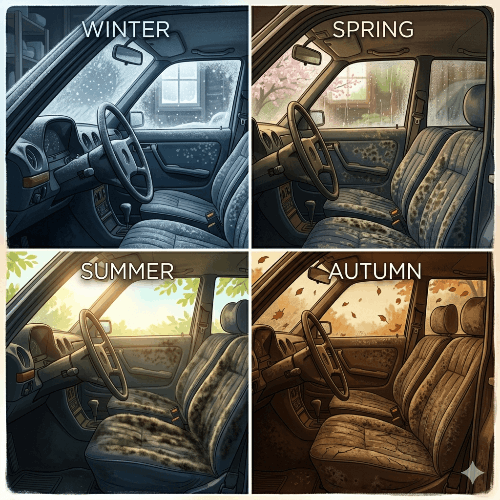
The Season-by-Season Breakdown

🌱 Spring

Highest mold risk. Rising temps + winter condensation = explosive growth on seats and headliners.

â˜€ï¸ Summer

Sustained warmth breeds mold fast. Heat also bakes mold into fabrics, making it harder to remove.

🂠Fall

Condensation season begins. Prep your vehicle now or pay the price come January.

â„ï¸Â Winter

Mold goes dormant but does NOT die. It waits. Temperature swings in storage keep moisture cycling.

Spring: The Season of Reckoning

Spring is when stored-car owners get the worst surprises. After months of fluctuating temperatures, condensation has been silently building up inside seat foam, carpet backing, and beneath floor mats. As the temperature climbs and humidity spikes, dormant mold spores that survived winter suddenly find everything they need to explode into visible colonies.

This is the season where you're most likely to find black, green, or white patches on upholstery and a musty odor that hits before you even open the door. According to Neighbor's car storage guide, black mold tends to cluster on fabric and ceiling material, while green mold often appears in corners and low-light areas of cars that have been idle the longest.

Spring Alert

Do not mistake a "clean" surface for a dry one. If carpet padding or seat foam was damp over winter, the surface may look fine while mold thrives 2–3 inches beneath. Always press down and smell — the nose knows before the eyes do.


Summer: The Silent Accelerator


If spring brings the first wave, summer doubles down on it. Warmth and humidity together dramatically shorten how long mold needs to establish. An interior that was borderline damp in May can become actively colonized by July. What makes summer particularly insidious for preventing mold in a stored vehicle is that high heat also bakes mold deeper into porous materials — by the time you smell it, removal is a significantly bigger job.

Vehicles stored in non-climate-controlled units in warm states like Georgia, Florida, or Texas face compounding risks. The Autopian's deep dive on mold in car storage illustrates how quickly summer conditions near lakes or in high-humidity zones can turn a mild mold issue into a near-total interior remediation situation.

HVAC systems are summer's biggest hidden casualty. Mold that reaches the ventilation ducts will circulate throughout the cabin every time you start the car — making this a direct car mold health risk for anyone who later drives the vehicle.

Fall: The Preparation Window You Can't Afford to Miss


Fall is your gift — if you use it. As temperatures start dropping, condensation cycles begin again. Warm humid air trapped inside the cabin meets cooler surfaces and leaves behind microscopic droplets on every organic material in the interior. By the time the first frost arrives, that moisture is already locked in.

This is your critical window for car storage mold prevention. Any car you're planning to store for winter needs serious pre-storage prep in fall: deep cleaning, full interior drying, desiccant placement, and seal inspection. According to Car Mold Guys' Storage Guide, humidity above 55% for even 24–48 hours is enough for mold spores to begin establishing — which means a single rainy week with your car sitting unchecked can set the stage for a spring nightmare.

Pay particular attention to sunroof drain channels and door weather seals in fall. Worn seals are the #1 entry point for moisture during autumn rains, and clogged drains overflow directly into carpet and insulation.

Winter: Dormant, But Never Gone


Here's the cold truth most car owners get wrong: cold does not kill mold. According to mold science covered by The Autopian, mold simply enters a dormant state when temperatures drop below the growth threshold. The moment conditions warm again, it reactivates. This is exactly why spring feels like such a sudden explosion of growth — the spores were there all along, just waiting.

Winter also creates its own moisture problem through temperature differentials. In unheated storage units or garages, warm days followed by frigid nights create condensation cycles that continuously deposit moisture on interior surfaces. A vehicle cover, while protective against dust, can actually trap this humidity underneath if it isn't breathable — creating a perfect mold incubator.

How to Remove Mold from Your Car Interior

If you're already facing an active mold problem, knowing how to remove mold from a car interior is essential — but approach it carefully. DIY removal is appropriate for surface-level growth on hard plastics and lightly affected fabric. For anything involving seat foam, carpet padding, or HVAC contamination, professional remediation is the safer bet.

  • Wear an N95 mask and gloves before opening the car — disturbing mold releases spores into the air
  • Identify and fix any moisture source first — a leak, clogged drain, or damaged seal. Cleaning without fixing the source is temporary
  • Use a white vinegar solution (1:4 for upholstery, 1:1 for carpets) or a commercial antimicrobial — avoid bleach on interior surfaces as it can damage materials
  • Work in sections, applying solution and blotting — never saturate fabric as excess moisture creates new mold conditions
  • After cleaning, leave doors open in dry conditions for at least several hours to ensure complete drying
  • Run the AC on max-cool and then dry air before closing the vehicle to dehumidify the cabin
  • Persistent odor after cleaning = moisture still present below the surface. At this point, pull the carpet and inspect padding

For guidance on professional-grade remediation options, the EPA's mold remediation framework provides an excellent baseline for understanding when DIY ends and professional help becomes necessary.

Car Mold Health Risks: What You're Actually Breathing


This section deserves more attention than it typically gets. Car mold health risks are real and can affect everyone in the vehicle — not just those with existing respiratory conditions. Mold spores circulating through a car's HVAC system create a constant low-level exposure with every drive. Common symptoms include worsening allergies, headaches, increased sneezing, eye irritation, and respiratory discomfort.

Certain mold species found in vehicle interiors can also trigger more serious responses in sensitive individuals. If you notice that you consistently feel better after getting out of a stored car, or that family members experience symptoms specifically while riding in it, take that seriously. The CDC's mold FAQ is an authoritative resource for understanding exposure thresholds and when to seek medical advice.

Your Season-by-Season Prevention Playbook


Control humidity. Keep interior humidity below 60%. Use DampRid, silica gel packets, or activated charcoal placed inside the cabin.  Breathable cover only. Never use plastic covers for stored cars — they trap moisture and create condensation. Use a breathable, moisture-wicking cover.  Inspect seals. Check all door, window and sunroof seals each fall. Clear all sunroof drains before storage season begins.  Deep clean before storing. Remove all organic material — crumbs, leaves, any food debris. Mold needs fuel, so deny it any.  Climate control if possible. Climate-controlled storage dramatically reduces mold risk by maintaining consistent temperature and humidity year-round.  Check every 4–6 weeks. Even a brief inspection — cracking doors, checking desiccants — interrupts moisture buildup before it becomes a mold problem.

The Bottom Line


Mold doesn't take a season off — it simply changes strategy. Spring brings visible damage from winter's hidden condensation. Summer accelerates growth into material-damaging territory. Fall is your window to prevent the whole cycle from repeating. And winter, despite appearances, is just a long pause before the next bloom.

The cars that emerge from long-term storage spotless aren't lucky — they were prepared. Understanding how each season loads the dice in mold's favor is half the battle. The other half is acting before you see (or smell) the problem. Because once mold is in the foam, it's already won the first round.

Stay ahead of the spores. Your lungs — and your resale value — will thank you.

Further reading:  CDC Mold FAQs · Classic Car Mold Prevention Guide · Mold Prevention After Flooding


Mold Growth Timeline in Wet Cars

Mold Growth Timeline in Wet Cars

How Long Does It Take for Mold to Grow in a Wet Car?

Your complete guide to car mold timelines, health risks, removal, and prevention

You left a window cracked during last night's rainstorm. Or maybe you spilled a drink on the back seat and figured it would dry on its own. Perhaps your car sat in a flooded parking lot for a few hours after a summer storm. Whatever the culprit, one question is now gnawing at you: How long does it take for mold to grow in a wet car?

The answer might surprise — and alarm — you. Car mold doesn't follow a polite schedule. It moves fast, hides well, and can seriously threaten both your health and your vehicle's value. Let's break down everything you need to know.

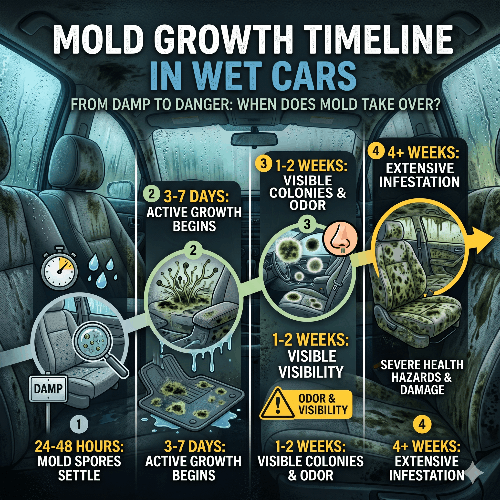
The Mold Clock Is Ticking: The Timeline You Need to Know

Here's the uncomfortable truth: mold can begin growing in your car in as little as 12 hours under the right conditions. In fact, you may notice that unmistakable musty mildew smell even sooner — sometimes within just 6 to 10 hours of moisture exposure.

As a general rule, mold will begin colonizing damp surfaces within 24 to 48 hours. But a car is not like a house. Vehicles are sealed, compact environments with limited airflow. That means heat and moisture build up faster inside your cabin than in most indoor spaces. Stagnant air, warmth, and dampness form a perfect trio for mold spores to flourish — and those spores are already present in the air around you.

The timeline breaks down roughly like this:

  • 0–6 hours: Moisture is absorbed into porous materials like carpet padding, seat foam, and fabric upholstery. The surface may look wet but no visible mold yet.
  • 6–12 hours: Musty odors begin to develop as microbial activity starts. This is your golden window to act.
  • 12–24 hours: Active mold colonization can begin, especially in warm, humid conditions.
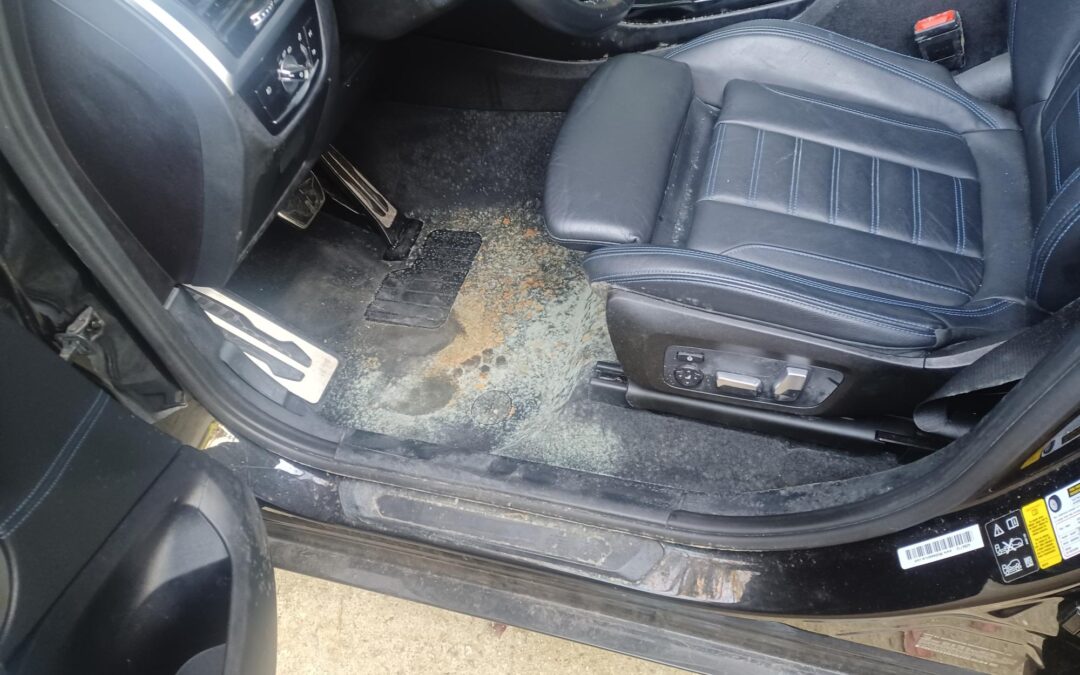
  • 24–72 hours: Visible mold patches may appear on fabric surfaces, floor mats, and under-seat areas.
  • 3–7 days: Without intervention, mold can spread to seat foam, HVAC ducts, door panels, and headliners.
  • 1+ weeks: A full-blown infestation can develop that may require professional remediation or even interior replacement.

The key variable? Temperature. Warm weather accelerates every stage of this timeline dramatically. If your car is parked in direct sunlight after getting wet, mold doesn't just walk through the door — it sprints.

Why Cars Are Especially Vulnerable to Mold Growth

Understanding car mold growth means understanding why your vehicle is practically a luxury resort for fungi. Several factors combine to make cars uniquely susceptible:

Porous materials everywhere. Fabric seats, carpet padding, headliners, and insulation are all designed to absorb — which means they hold moisture long after the surface feels dry to the touch. Foam beneath upholstery can stay damp for days even when the visible surface seems fine.

Limited ventilation. Unlike your home, which has HVAC systems cycling air constantly, a parked car is essentially a sealed box. Moisture has nowhere to escape.

The AC evaporator trap. Your air conditioning system naturally accumulates moisture on its evaporator coil. If that component doesn't fully dry out between uses, it becomes a hidden mold factory — one that recirculates spores through your entire cabin every time you turn on the fan.

Common entry points for water include spilled beverages, rain through open windows or a cracked sunroof, worn door seals, flooded parking areas, wet clothing and sports gear left inside, and condensation from temperature swings.

Even something as innocent as bringing your gym bag inside the car on a humid day can introduce enough moisture to start the process.

The Health Risks of Mold in Your Car

This isn't just about a bad smell. Mold in car interiors poses real, documented health risks — and the confined space of your vehicle makes them worse.

When you're driving with the heater or AC running, you're breathing recirculated air. If mold or mold spores are present anywhere in your HVAC system, you're inhaling them continuously. Health effects can include:

  • Respiratory irritation and shortness of breath
  • Nasal congestion and wheezing
  • Skin and eye irritation
  • Headaches and fatigue
  • Worsening of asthma and allergy symptoms
  • In cases of prolonged exposure, long-term lung issues and immune system changes

People with pre-existing respiratory conditions, allergies, or weakened immune systems face the greatest risk. But even healthy individuals aren't immune — chronic, low-level exposure to mold spores takes a cumulative toll.

One mold species deserves special mention: Stachybotrys chartarum, commonly known as black mold. While not the most common type found in cars, its presence brings a more serious set of symptoms including neurological effects, mood disturbances, and in extreme cases, severe respiratory illness.

If you're sneezing every morning on your commute, developing headaches that disappear once you leave your car, or noticing that your allergy symptoms seem worse inside the vehicle than out, mold could be your culprit — even if you haven't spotted any visible growth yet.

Learn more about mold health risks from the CDC's official mold resource page.

How to Spot Mold in Your Car Before It Gets Worse

Early detection is everything. Mold is often well-established before it becomes visible, so don't wait for a green fuzzy patch to take action. Warning signs include:

Sensory clues:

  • A musty or earthy odor that intensifies when the AC or heat is running
  • Persistent stale smell that doesn't go away after airing the car out
  • Allergy-like symptoms that seem triggered by being in the car

Visual clues:

  • Discoloration on fabric seats, carpet, or headliner
  • Fuzzy or slimy patches in corners, under seats, or along door seams
  • Staining along seat belt webbing or around air vents
  • Mold can appear in white, gray, green, brown, or black

Problem areas to check:

  • Under all floor mats and seat covers
  • Beneath and behind all seats
  • In the trunk and spare tire well
  • Along door panel seams and storage pockets
  • Inside air vents (use a flashlight)
  • Under the dashboard near the AC evaporator

How to Remove Mold from Your Car Interior

Caught it early? Here's a step-by-step approach to mold removal from car interior surfaces.

What you'll need:

  • N95 or P100 respirator mask
  • Rubber gloves and eye protection
  • Stiff-bristled brush
  • HEPA vacuum
  • White vinegar or enzyme-based cleaner
  • Microfiber cloths
  • Dehumidifier or fan

Step-by-step process:

  1. Move the car into direct sunlight and open all doors and windows. Allow 20–30 minutes of ventilation before working inside.
  2. Put on all PPE before entering the vehicle.
  3. Use a stiff brush to gently loosen mold from fabric, carpet, and crevices. Work carefully to avoid spreading spores.
  4. HEPA vacuum all loosened mold, debris, and affected surfaces thoroughly.
  5. Apply your cleaning solution. White vinegar diluted with water (1:1 ratio) works well for many surface types. Spray liberally on affected areas, let it sit for 15–20 minutes, then scrub and blot dry with a microfiber cloth.
  6. Dry everything completely. This is non-negotiable. Use a dehumidifier inside the car, fans directed at wet areas, or park in direct sunlight with doors open. Moisture that remains below the surface will allow mold to return.
  7. Replace your cabin air filter. This is often overlooked but critical — a moldy or clogged cabin filter recirculates spores through your entire ventilation system.

When to call a professional: If the mold has penetrated seat foam or carpet padding, spread to HVAC components, or covers a large area, DIY methods are likely to fail. Professional car mold remediation can cost several hundred dollars but may be the only way to fully address a serious infestation. In the worst cases, full interior replacement may be necessary.

For a detailed DIY guide, check out AutoGuide's mold removal walkthrough.

Preventing Mold in Your Car: Simple Habits That Make a Big Difference

The best mold remediation is the mold you never get. Preventing mold in car interiors comes down to moisture control and regular maintenance.

Immediate habits:

  • Clean up spills immediately — don't leave wet items in the car and assume they'll dry on their own
  • Keep windows closed when parked, especially if rain is possible
  • Shake out wet umbrellas and jackets before placing them in the car
  • Avoid leaving wet gym bags, towels, or sports equipment in the vehicle overnight

Ongoing maintenance:

  • Replace your cabin air filter every 12,000 to 15,000 miles (more frequently in humid climates like the American South)
  • Run the AC or heat periodically to circulate and dry air inside the cabin
  • Use silica gel packs or a car dehumidifier if you live in a particularly humid area
  • Inspect under seats and mats monthly for early signs of moisture
  • Get door seals and window seals checked if you notice unexplained dampness after rain

After flooding or heavy moisture intrusion:

  • Act within the first 12 hours if possible
  • Use a wet/dry vacuum to extract as much water as possible
  • Lift floor mats and pull back carpet edges to check padding underneath
  • If padding is saturated, it may need to be removed and replaced

For more mold prevention tips, visit PuroClean's car mold remediation guide.

What About Car Insurance and Mold Damage?

Here's a curveball many car owners don't anticipate: most standard auto insurance policies do not cover mold damage unless it directly results from a covered incident (like a flood covered under comprehensive coverage). Mold from a slow leak you neglected or a window you left open is typically classified as a maintenance issue — and that's on you.

Beyond insurance, mold has a measurable impact on resale value. Buyers and dealerships recognize mold as both a health liability and a sign of water damage history. A persistent musty odor, visible staining, or a documented remediation history can significantly reduce what your car is worth on the used market.

The takeaway: address mold quickly and thoroughly, document your remediation efforts, and invest in prevention — your health, your wallet, and your future resale price all depend on it.

Quick Reference: Mold Timeline at a Glance

Time After Water Exposure What's Happening
0–6 hours Moisture absorbed into porous materials
6–12 hours Musty odors begin; act NOW
12–24 hours Active mold colonization begins
24–72 hours Visible patches may appear
3–7 days Spreads to HVAC, foam, door panels
1+ weeks Full infestation; professional help likely needed

Final Thoughts

Mold in a car is not a problem that resolves itself. It doesn't wait patiently while you decide what to do, and it certainly doesn't disappear when temperatures drop (cold weather slows mold growth but doesn't kill it — spores simply go dormant and revive when conditions improve).

The moment you notice moisture, a musty smell, or any suspicious discoloration inside your vehicle, treat it as an urgent situation. The 12-hour window is real. The health risks are real. And the financial cost of ignoring the problem is real.

Act fast, dry thoroughly, and keep your cabin clean and ventilated. Your car — and your lungs — will thank you.

Related reading:

The dangers of car mold and why it should be taken seriously.

The dangers of car mold and why it should be taken seriously.

Is There Mold in Your Car? Here's Why You Can't Afford to Ignore It

Mold doesn't need much of an invitation. A little moisture, a forgotten coffee spill, a leaky window seal — and within 24 to 48 hours, mold spores can take hold inside your vehicle. What starts as a faint musty smell can quickly turn into a full-blown health hazard that affects everyone who rides in your car.

If you've noticed an unusual odor, visible dark spots on your seats or carpet, or you're sneezing every time you get behind the wheel — this article is for you.


Why Car Mold Is More Dangerous Than You Think

Car mold is just as serious as house mold — and in many ways, it's worse. The risks are amplified by three factors that most people never consider: a small confined area, a ventilation system that blows directly on occupants, and constant vibration that shakes spores loose and keeps them suspended in the air you're breathing.

Most people assume mold is just an aesthetic problem — something unsightly but harmless. That's a costly misconception. Car mold is a biological contaminant that thrives in the enclosed, often poorly ventilated space of a vehicle. Because you're sealed inside with it every time you drive, your exposure is concentrated and repeated.


The Health Risks of Car Mold Exposure

According to the Centers for Disease Cobtrol and Prevention (CDC), mold exposure can cause a wide range of health issues, particularly affecting the respiratory system. Inside a car, those risks are amplified because you're breathing in a closed environment with limited airflow.

Common symptoms of mold exposure include:

  • Chronic coughing and sneezing
  • Watery, itchy eyes
  • Throat irritation and nasal congestion
  • Skin rashes or irritation
  • Headaches and fatigue
  • Worsening asthma or allergy symptoms

For people with compromised immune systems, existing respiratory conditions, or mold allergies, the consequences can be severe. The American College of Allergy, Asthma & Immunology (ACAAI) notes that mold allergies can trigger asthma attacks, and prolonged exposure can lead to hypersensitivity pneumonitis — a serious lung condition that can be mistaken for pneumonia.

Bottom line: If you're driving with mold in your car daily, you're not just uncomfortable — you're putting your health at real risk every single trip.


How Mold Damages Your Vehicle

Beyond your health, mold causes serious physical damage to your car's interior. Mold produces enzymes that break down organic materials — and your car's interior is full of them: fabric seats, carpet, foam padding, leather, and even the headliner.

Left untreated, mold can:

  • Permanently stain and deteriorate upholstery and carpet
  • Break down foam padding inside seats
  • Corrode metal components beneath carpet and floor mats
  • Compromise the structural integrity of interior panels
  • Infiltrate your HVAC system, spreading spores every time you use your heat or A/C

Once mold gets into your car's ventilation system, it circulates throughout the entire cabin every time you turn on the air. This is one of the most dangerous — and overlooked — aspects of car mold contamination.


The Impact on Your Vehicle's Value

Thinking about selling your car? Mold is one of the fastest ways to destroy resale value. Even if the mold is removed, lingering odors and visible staining can be a dealbreaker for buyers. Carfax and vehicle inspection services increasingly flag odor and interior damage, and a moldy car on a dealer lot — or in a private sale — is a car that sits unsold.

According to Kelley Blue Book, interior condition is one of the top factors that affects used car value. Mold damage can reduce a vehicle's market value by hundreds or even thousands of dollars depending on severity.

Investing in professional mold remediation early isn't just about health — it's about protecting a major financial asset.


Where Does Car Mold Come From?

Understanding the source helps prevent recurrence. The most common causes of car mold include:

  • Wet carpets from tracked-in rain or flooding
  • Spilled drinks or food left to sit in warm conditions
  • Leaking windows, sunroofs, or door seals
  • Leaving windows down during rain
  • Condensation buildup in humid climates (especially in the South)
  • A/C systems that collect moisture and don't dry properly

The Southeast's hot, humid summers create the perfect breeding ground for mold growth. Vehicles parked in garages or shaded areas with poor ventilation are especially vulnerable.

DIY vs. Professional Mold Removal: What's the Difference?

You'll find plenty of tutorials online for removing car mold with vinegar, bleach, or baking soda. While these methods can address minor surface mold, they almost never eliminate the problem completely. Here's why:

  • Mold roots (hyphae) penetrate deep into porous materials — foam, carpet backing, and fabric — where surface sprays can't reach
  • Improper treatment can spread spores to unaffected areas, making the problem worse
  • Odors return because the underlying biological contamination wasn't fully addressed
  • No post-treatment verification means you're guessing, not knowing

A professional auto mold remediation service uses HEPA-filtered equipment, EPA-registered antimicrobials, and containment protocols to ensure complete removal. Post-treatment testing confirms the mold is gone — not just masked.

The EPA's guidelines on mold remediation emphasize that porous materials with significant mold growth typically need to be removed and replaced — not just cleaned — to achieve lasting results.


Signs You Need Professional Car Mold Remediation

Don't wait until the problem is severe. Contact a professional if you notice:

✅ A persistent musty or earthy odor that doesn't go away
✅ Visible dark spots (black, green, or white) on seats, carpet, or headliner
✅ Unexplained allergy-like symptoms that improve when you're out of the car
✅ A history of flooding, significant water intrusion, or chronic moisture issues
✅ Your A/C or heat smells musty when it blows


Take Action Before Mold Takes Over

Car mold isn't a problem that resolves on its own — it spreads. Every day you wait is another day the contamination grows deeper into your vehicle's materials and your lungs.

If you're in Georgia and you suspect mold in your vehicle, don't guess — get it handled by a specialist. At Car Mold Guys, we use professional-grade equipment and proven remediation protocols to fully eliminate mold from your vehicle's interior — and keep it gone.

📞 Contact us today for a free assessment and let us restore your car — and your peace of mind.


Frequently Asked Questions About Car Mold

Can car mold make you sick?
Yes. Mold exposure in a vehicle can cause respiratory issues, allergic reactions, headaches, and in severe cases, serious lung conditions — especially with repeated daily exposure.

How long does it take for mold to grow in a car?
Under the right conditions (warmth and moisture), mold can begin growing within 24–48 hours of water intrusion.

Is car mold covered by insurance?
In some cases, yes. If mold resulted from a covered event like flooding, your comprehensive auto insurance may cover remediation. Check with your provider.

Can I remove car mold myself?
DIY methods can address very minor surface mold, but professional remediation is recommended for any significant growth to ensure complete removal and prevent regrowth.


Published by Car Mold Guys — The Southeast's mobile auto mold remediation specialists. Serving the entire Southeast.

Call Today!