
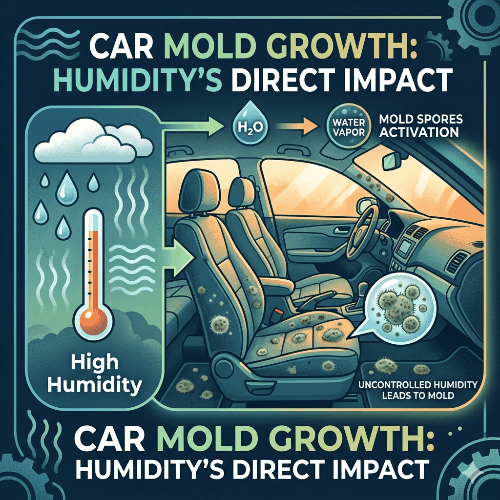

How Humidity Levels Directly Trigger Car Mold Growth
You park your car. A week passes. You open the door and catch that unmistakable musty smell — the kind that clings to fabric and refuses to leave. Humidity is the silent culprit, and it doesn't need a flood to do its damage. Mold follows one predictable biological trigger: moisture. Specifically, it's the relative humidity inside your car's cabin that decides whether mold spores — always present in the air — stay dormant or burst into active, spreading colonies.
What Relative Humidity Is — and Why Your Car Traps It
Relative humidity (RH) measures how much water vapor is in the air compared to the maximum it can hold at a given temperature. Your car's cabin is a sealed micro-environment: it traps moisture from wet shoes, damp clothing, the breath of passengers, spilled drinks, and rain that seeps past imperfect door seals or a clogged sunroof drain. Unlike your home, a parked car has essentially no natural air exchange.
On a humid summer day in cities like Atlanta, Miami, or Houston, ambient RH can already sit at 75–90%. Inside a closed, dark, stationary car, that moisture has nowhere to go. Seats, carpet padding, and headliner foam absorb it readily — producing a microclimate that's often more humid than the outside air, the ideal setting for mold to shift from dormant to active. According to the U.S. Environmental Protection Agency, mold needs only two things to grow: a moisture source and an organic food source — and a car interior supplies both in abundance.
“A car interior left closed in humid conditions for 48 hours can accumulate enough moisture in its soft materials to sustain active mold growth for weeks — even after the surface of those materials feels dry to the touch.”
The Humidity-to-Mold Spectrum: What Each Level Means
Not all humidity levels carry the same risk. Here's how relative humidity maps directly to mold danger inside a vehicle cabin:
| Relative Humidity | Risk Level | What This Means Inside Your Car |
|---|---|---|
| Below 50% | Safe | Mold spores remain dormant. Ideal for storage and daily driving in any climate. |
| 50–60% | Caution | Elevated risk above 70°F. Monitor closely — prolonged exposure can activate spores. |
| 60–70% | High Risk | Mold spores begin to germinate. Musty odors can emerge within 48 hours if sustained. |
| 70–85% | Severe | Rapid colony formation. Visible growth on seats, carpet, and upholstery within days. |
| Above 85% | Critical | Mold doubles in size every few hours. Foam, padding, and headliner backing begin to degrade. |
The Biology of It: How Humidity Wakes Mold Up
Mold is a fungus that reproduces through microscopic spores, and those spores are everywhere — in the air you breathe, on every interior surface, drifting in through your windows. Under dry conditions, they're biologically dormant. They're simply waiting.
When relative humidity climbs above 60%, spores begin absorbing moisture directly through their cell membranes. That triggers germination: the spore cracks open, extends hyphal threads (the root-like filaments of mold), and starts colonizing whatever it has landed on. In a car, that surface is almost always porous — seat fabric, carpet fibers, foam padding, leather stitching, rubber gaskets, and the foam backing of door panels and headliners.
Temperature accelerates the process dramatically. At 77°F and 70% RH, visible colonies can form within 24 to 48 hours — heat and moisture aren't simply additive, they're multiplicative. The National Institute of Environmental Health Sciences (NIEHS) confirms that warm, damp, enclosed environments are exactly where mold colonizes most aggressively.
A brief spike to 65% won't cause mold. Sustained exposure above 60% for 12 hours or more in warm conditions almost certainly will. That's why a vehicle left closed over a long, humid weekend — even without any leak — is genuinely at risk.
Where Mold Colonizes First in Your Car
Mold doesn't appear everywhere at once. It follows a predictable path, targeting the most moisture-retentive materials first. These are the six locations that activate earliest — and that are most often missed:
Dense polyurethane foam traps humidity for days, long after the surface feels dry, and the fabric weave gives hyphal threads ideal anchor points. By the time a colony is visible on the surface, the foam interior is already heavily contaminated.
Water from shoes, spills, and seal leaks pools beneath the mats where it can't evaporate. The padding under the carpet is typically the single most contaminated material in a mold-affected vehicle — and it's invisible until removed.
The evaporator coil collects condensation every time you run the A/C, and every time you turn on the fan, spores blow straight into the air you breathe. The ventilation system is why a musty odor returns right after cleaning — because it was never treated.
Headliner fabric is glued to a foam backing pressed against the metal roof. When sunroof drains clog or seals fail, moisture wicks into that backing and mold spreads silently overhead — often invisible until you notice subtle sagging, faint staining, or a smell strongest near the roofline.
The fiberboard backing inside door panels absorbs water from degraded seals. The trunk is especially vulnerable: seals degrade with age, and the spare-tire well is a basin by design — any water that enters has nowhere to drain. Trunk mold can go undiscovered for years.
Food debris, tracked-in moisture, and spilled drinks pool in the recessed channels beneath the front seats. Low light, poor airflow, and accumulated organic material make this one of the most overlooked and reliably mold-prone spots in any vehicle.
Humidity Sources Most Drivers Never Think About
The assumption that car mold only follows a major flood is one of the costliest misconceptions in vehicle ownership. Slow, everyday moisture accumulation is far more common — and far more insidious:
- Passenger respiration — a person exhales roughly 300 ml of water vapor per hour. Four passengers on a two-hour drive add meaningful moisture, especially with the windows closed.
- Wet umbrellas, clothing, and gear — left on the seat or in the trunk, these off-gas moisture for hours into a sealed cabin.
- A blocked A/C condensate drain — when the evaporator drain clogs, condensation backs up under the dash and soaks the passenger floor, often for weeks before anyone notices.
- Sunroof drain tube failure — the single most frequent source of vehicle water intrusion, routing rainwater silently into the A-pillars and floor carpet over months.
- Degraded door and trunk seals — even a hairline failure lets water track in along the sill with every heavy rain, soaking the carpet edge where it's least likely to be seen.
- Spills that were never fully dried — surface blotting doesn't reach the foam padding beneath, which stays a sustained mold incubator long after the surface feels dry.
The Health Consequences of Car Mold Exposure
Because a cabin is so small and so sealed, mold contamination creates a uniquely concentrated exposure environment. Many drivers who spend one to three hours a day in their car never connect their symptoms to their vehicle — until they drive a different car for a week and feel noticeably better.
NIEHS associates mold exposure with upper-respiratory irritation, coughing, wheezing, eye and throat irritation, and the aggravation of asthma. Children, elderly passengers, and anyone immunocompromised face elevated risk. Beyond spores, certain species produce mycotoxins — toxic compounds smaller and more biologically active than spores, which penetrate deeper into lung tissue and aren't addressed by surface cleaning of any kind.
Cleaning mold incorrectly — including the steam cleaning many detailers use — can fragment mold colonies, sharply increasing airborne particles in the cabin. Those fragments are smaller, more numerous, and more biologically active than intact spores — so improper treatment doesn't fix a mold problem, it can make it measurably worse.
Humidity Control: Prevention Habits That Actually Work
For vehicles without an active mold problem, consistent humidity management is the most effective and least expensive approach available. These habits cost nothing but attention:
- Run the A/C regularly, even in mild weather — it doubles as a dehumidifier, keeping interior humidity below the 60% germination threshold.
- Switch to fresh-air mode before parking — running the fan on fresh air for the last few minutes of a drive dries the evaporator coil and ducting where mold most often establishes.
- Place silica-gel desiccant packs under seats and in the trunk — reusable bags passively absorb moisture between uses, invaluable in the humid Southeast from May through October.
- Never leave wet items in a closed car — a single wet gym bag overnight can push interior humidity well past the activation threshold.
- Inspect door and trunk seals annually — close a dollar bill in the door; if it slides out with little resistance, the seal has lost its compression and should be replaced.
- Replace your cabin air filter on schedule — ideally with a higher-grade MERV 13 filter, and sooner if you drive in humid climates; a clogged, damp filter holds moisture right upstream of your vents.
- Address any spill within 24 hours — completely — the EPA's guidance is clear that drying within 24–48 hours is critical; extract with a wet/dry vacuum rather than just blotting.
- Have sunroof drain tubes inspected — drain failure is the leading cause of intrusion, and inspection costs a fraction of remediation once mold reaches the A-pillar and floor.
The Only Professional Car Mold Remediation Company in the Country
Car Mold Guys isn't a detailing company that also removes mold. Professional vehicle mold remediation is all we do — and after a nationwide search for comparable providers, we found none that met our full criteria. We're a genuine one-of-one company.
With 13 years of experience, more than 2,500 completed projects, and over 216 verified five-star Google reviews, every process we use is built around the ANSI/IICRC S520 Standard — the same benchmark applied to water-damaged homes and commercial buildings. We don't detail cars; we restore them to genuinely safe air quality.
| 100% dedicated to vehicle mold | Water-leak diagnostics & repair |
| Carpet padding removal & replacement | Chlorine dioxide gas treatment |
| Professional HVAC ventilation purge | Air-quality testing at completion |
| ANSI/IICRC S520-aligned processes | 100% mobile — we come to you |
| Encapsulation to prevent regrowth | 90-day warranty on every job |
Frequently Asked Questions
What relative humidity level causes mold in a car?
The activation threshold is 60% RH — but duration matters as much as level. A brief spike to 62% won't cause mold; sustained exposure above 60% for 12 hours or more in warm conditions almost certainly will. In a closed car during a humid summer, interior RH can exceed that within hours of parking.
Can mold grow in a car in winter?
Yes — more slowly, but it can. Cold slows mold metabolism without stopping it; humidity above 60% can support growth down to about 40°F. The sharper danger comes when a cold, mold-colonized car is warmed up — spore counts spike as dormant colonies reactivate.
How do I know if mold is in my car's HVAC system?
The main indicator is a musty smell that intensifies when you first turn on the fan, especially on recirculation. If it improves on fresh-air mode, the source is likely the evaporator core or cabin filter. Replacing the filter is the first step; if the odor persists, the ducting and evaporator housing need professional treatment.
Is white mold less dangerous than black mold?
Color alone doesn't determine toxicity — the species does. White mold, often Penicillium or Aspergillus, can produce mycotoxins just as harmful as those from Stachybotrys chartarum (black mold). All vehicle mold should be treated as a health hazard, regardless of color.
Why does mold keep coming back after cleaning?
Because cleaning addresses the symptom, not the cause. If the moisture source was never located and repaired, and the contaminated padding and foam were never replaced, the mold returns — reliably, often within weeks. That recurrence is the signature of detailing-based "mold removal," where the structural contamination was never resolved.
Can high humidity alone cause car mold without a leak?
Yes — particularly when a vehicle sits sealed for long stretches in humid conditions. But in the majority of active cases, the root cause is a leak: ambient humidity creates the conditions, while a leak creates the sustained moisture reservoir that makes serious colony formation in padding and foam nearly inevitable.
Your car can be truly safe again
We find the leak, dry the vehicle, remediate every surface — seen and unseen — and verify the air quality before we leave. No detailer in the country does what the specialists at Car Mold Guys do. 100% mobile across Georgia, South Carolina, North Carolina, Tennessee, Florida, and Alabama, backed by a 90-day warranty.