
Children and Car Mold: Why Kids Are More Vulnerable Than Adults
That musty smell in your vehicle isn't just unpleasant — for your smallest passengers, it can be genuinely harmful. Millions of families pile into the car every day for school runs and road trips without realizing they may be sharing the cabin with mold. And the same exposure that a grown adult might shrug off affects a child's body far more severely.
If you've noticed a faint musty odor in your vehicle, or watched your child sneeze and cough on every ride, here's what the science actually says — and why kids face a disproportionately higher risk.
How Mold Takes Hold in Your Car
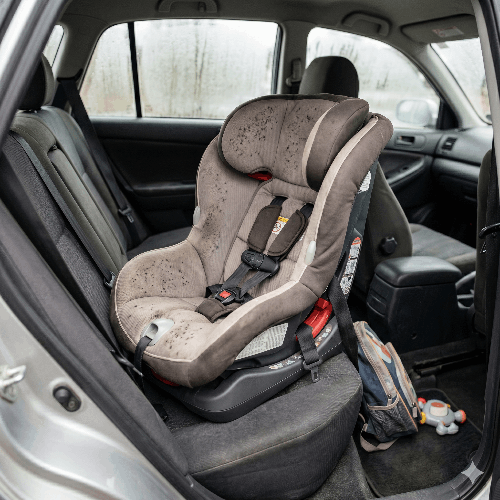
Cars are close to a perfect breeding ground: small, often poorly ventilated, frequently damp — from rain, wet umbrellas, spilled drinks, or plain humidity — and lined with organic materials like fabric, carpet, foam padding, and leather. All mold needs is moisture and something to feed on, and a car interior offers both in abundance. According to the U.S. Environmental Protection Agency, mold can begin colonizing a damp surface in as little as 24 to 48 hours.
The common hotspots are mostly out of sight: under the floor mats, inside the HVAC vents, beneath the seats, in the trunk lining, and along the headliner. The species that turn up most often include Stachybotrys chartarum (black mold), Aspergillus, and Cladosporium — several of which can produce mycotoxins.
⚠️ The HVAC delivers it straight to the car seat
When you turn on the climate system, it can circulate mold spores and mycotoxins throughout the cabin — delivering them to passengers with every breath. Children in rear car seats sit closest to the floor and the lower vents, which happen to be the most mold-prone areas in the vehicle.
Why Children Are Significantly More Vulnerable
Adults and children are not equal when it comes to mold exposure. The biological differences are real, and they all tip the scales toward greater harm in younger bodies — through three core vulnerabilities.
1. Still-developing immune systems
A child's immune system is still being built, and hasn't fully learned to identify and neutralize environmental threats like mold spores. That makes children more likely to experience allergic reactions, respiratory infections, and inflammation on exposure — where a healthy adult might tolerate the same low-level exposure with little reaction.
2. Smaller airways — the critical difference
This is where the physiology becomes especially serious. The World Health Organization has documented a striking disparity: a one-millimeter loss of airway diameter causes roughly a 19% reduction in airflow for an adult — but about a 56% reduction in a child. Mold-induced inflammation swells and narrows the airways, which is exactly why it's so much more dangerous in a small child.
“A child who loses 1mm of airway diameter to mold-induced inflammation loses 56% of their airflow — compared with just 19% in an adult.”
3. Faster, deeper breathing
Children breathe more rapidly than adults, and because they're smaller, they take in significantly more air per pound of body weight. So for every minute in a contaminated cabin, a child inhales a far higher concentration of spores and mycotoxins relative to their body mass than any adult sitting in the same car.
Adults vs. Children, Side by Side
| Vulnerability Factor | Adults | Children |
|---|---|---|
| Immune system | Fully developed | Still developing — less able to neutralize mold toxins |
| Airflow lost to 1mm of swelling | About 19% | About 56% |
| Air intake per body weight | Lower ratio | Much higher — more spores per pound inhaled |
| Airways | Full size | Narrow — small swelling has an outsized effect |
| Organ sensitivity | Mature | Lungs and organs still growing — more sensitive |
| Long-term risk | Manageable once removed | May contribute to lasting asthma and sensitivities |
Symptoms to Watch For
Mold symptoms in children are easy to mistake for a common cold. The telling pattern is timing: symptoms that consistently worsen during or after car rides and ease when your child is away from the vehicle. Watch for these signs in particular:
|
Nasal symptoms in the car Sneezing, runny nose, or congestion that worsens during the ride. |
Irritated eyes Watery, itchy, or red eyes during or after car journeys. |
|
Coughing or wheezing Shortness of breath, especially in a child who already has asthma. |
Skin irritation Rashes, hives, or unusual irritation without another clear cause. |
|
Headaches or fatigue Headaches, dizziness, or tiredness that follow time in the vehicle. |
Lingering congestion Chronic respiratory symptoms that never quite fully resolve. |
If these track with car rides, take that seriously — and if a child has persistent or worsening breathing symptoms, talk with your pediatrician. This article is general information, not medical advice.
The Long-Term Picture
The concern isn't only the acute reaction — it's what repeated exposure does over months and years. The National Institute of Environmental Health Sciences notes that mold exposure can both raise the risk of developing asthma and worsen it in children who already have it. Research has also linked early-life mold exposure to heightened sensitivity to other allergens — dust mites, pollen, pet dander — that can follow a child into adulthood. The encouraging part: when the source is found and fully removed, children's symptoms often improve quickly. Early action makes the difference.
What to Do If You Suspect Mold
A surface wipe of a visible spot on a hard, non-porous surface can be reasonable for a tiny, early patch. But once mold has reached the carpet, the foam padding, or the HVAC system — and especially when children ride in the vehicle — this isn't a DIY job. A car is small and porous, the contamination is usually deeper than it looks, and disturbing mold without proper containment can raise a child's exposure rather than lower it.
The approach that actually protects kids
Real remediation finds and repairs the moisture source, physically removes the contaminated padding rather than spraying over it, treats with chlorine dioxide that penetrates porous materials, purges the HVAC system, installs a MERV 13 cabin filter, encapsulates against regrowth, and verifies the air quality before the vehicle goes back into service. Keep children away from the car entirely until that's done.
Prevention helps too: never leave wet items in a closed car, clean up spills promptly, run the climate system on fresh-air mode for the last few minutes of a drive to dry the evaporator, and have any persistent interior fogging investigated for a leak rather than ignored.
The Bottom Line
Car mold isn't a minor inconvenience for a child. Whether it's a 10-minute school run or a two-hour road trip, the exposure adds up — and a child's developing immune system, smaller airways, and faster breathing make them categorically more vulnerable than the adults in the same car. Trust your nose, take a musty smell seriously, and when in doubt get a professional assessment — a child's respiratory health is worth it. When it's more than a small surface spot, Car Mold Guys handles the vehicle end to end so your kids can breathe clean air again.
Protect Your Smallest Passengers
If there's a musty smell in a car your children ride in, don't wait it out. Car Mold Guys finds the leak, removes the contaminated padding, treats with chlorine dioxide, and verifies the air quality before you drive again — mobile to your door, backed by a 90-day warranty across GA, SC, NC, TN, FL, and AL.
Sources: EPA — Mold · NIEHS — Mold · WHO — Dampness and Mould