
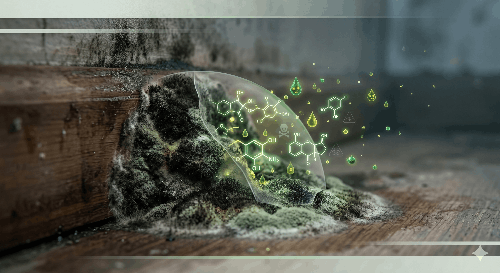
Mycotoxins: The Hidden Poison Inside Mold
You've seen the black streaks creeping along a bathroom ceiling, or found fuzzy growth on the seat of a water-damaged car. You know mold is bad. But most people don't realize that the mold itself is only half the problem. The other half is what mold produces — invisible, often odorless chemical compounds called mycotoxins. They linger long after the visible growth is gone, embed themselves deep into the materials you sit on and breathe near, and quietly affect your health for months or years.
What Exactly Are Mycotoxins?
The word comes from the Greek mykes (fungus) and the Latin toxicum (poison). In plain terms, mycotoxins are toxic compounds produced by certain species of mold as they grow. They aren't the mold itself — they're the chemical byproducts it releases as it feeds, competes with other organisms, and spreads. Think of it this way: the mold is the factory, and mycotoxins are the waste it dumps into your environment.
Researchers have identified more than 400 of them, but a handful account for most of the health concern. Here are the ones that matter most:
And here's the fact almost everyone misses: mycotoxins are not destroyed by killing the mold. They're chemically stable compounds that stay embedded in porous materials — upholstery, carpet padding, foam, headliner backing — long after the colony that produced them is dead.
“Wiping a surface down may kill mold on contact — but the mycotoxins it already produced remain in the porous material underneath, and they don't expire on a schedule.”
Why a Car Is the Worst Place to Find Them
Mycotoxins turn up wherever mold grows unchecked — water-damaged buildings, basements, crawl spaces. But one location catches people completely off guard: the inside of their own vehicle.
A single water intrusion event — a slow sunroof leak, a spilled drink soaked into the carpet underlayment, a window left cracked in a storm — can trigger rapid growth in a warm, sealed cabin. Car interiors are built almost entirely from porous material: foam seat padding, fabric, carpet backing, headliner. Mycotoxins bind deep into those materials, and the HVAC system then blows air across them straight into the breathing zone of every passenger. It's a small, enclosed space with no meaningful air exchange — which is exactly why concentrations inside a vehicle can exceed those in a large open room.
The Health Effects Worth Taking Seriously
How mycotoxins affect you depends on which compounds are present, how concentrated the exposure is, and how long it lasts — along with individual factors like age, immune status, and existing respiratory conditions. Children are especially vulnerable, since they breathe more air relative to their body weight and their immune systems are still developing. These are the short-term signs people notice first:
Persistent headaches, unusual tiredness, and difficulty concentrating.
Congestion, runny nose, chronic cough, wheezing, or shortness of breath.
Watery, itchy, or burning eyes that ease once you're out of the vehicle.
Rashes, hives, or unexplained irritation after time in the car.
Existing asthma that reliably worsens during or after car trips.
Lightheadedness or queasiness that tracks with time spent in the cabin.
Longer term, sustained exposure is where the research gets more serious. The World Health Organization treats mycotoxins as a genuine public-health concern, and the National Institute of Environmental Health Sciences associates prolonged mold exposure with:
Liver damage and liver cancer — the basis for aflatoxin B1's Group 1 carcinogen classification.
Kidney toxicity — associated particularly with ochratoxin A.
Immune suppression — leaving the body more open to secondary infections.
Chronic respiratory disease — including hypersensitivity reactions in the airways and lungs.
People who feel inexplicably unwell — chronically congested, foggy, tired — sometimes discover much later that their car had been quietly exposing them the whole time. If a musty smell is the only clue you have, that smell is itself meaningful: it's microbial VOCs from an active colony, which means the mycotoxin question is worth answering.
What Doesn't Neutralize Mycotoxins
This is where most advice on the subject goes wrong. Because mycotoxins are chemically stable and buried inside porous material, several popular "solutions" don't actually solve anything:
Ozone generators. Ozone is a surface deodorizer. It masks and oxidizes odor at the surface, doesn't reliably reach mycotoxins bound inside foam and padding, and degrades the rubber seals that keep water out of your car in the first place.
Bleach. It may kill surface mold, but it doesn't penetrate porous materials and it doesn't neutralize the toxins already deposited there. It also damages fabric and leather.
Encapsulant sealers. Sealing contaminated material in place is not remediation — it's a lid on the problem, and one that fails as soon as the material is disturbed or gets wet again.
Any surface spray, generally. If contaminated padding stays in the vehicle, so do the mycotoxins. That's why the smell always comes back.
What Actually Works: The Professional Protocol
Eliminating mycotoxins requires removing the contaminated material and treating what remains with something that penetrates rather than coats. This is the sequence Car Mold Guys follows on every vehicle, aligned to the ANSI/IICRC S520 standard for professional mold remediation:
|
1
|
Find and repair the moisture source
Mold — and the mycotoxins it produces — will return indefinitely if the water doesn't stop. Leak diagnosis and repair comes first; everything else is wasted effort without it. |
|
2
|
Remove the contaminated porous material
Heavily colonized carpet padding and foam can't be decontaminated in place. It comes out and gets replaced. There is no shortcut around this step. |
|
3
|
HEPA vacuum and scrub the air
Spores carry mycotoxins on their surface. HEPA-rated vacuums and air scrubbers capture those particles instead of redistributing them through the cabin during the work. |
|
4
|
Treat with chlorine dioxide gas
A gas-phase oxidizer penetrates deep into porous surfaces and chemically breaks down what liquid treatments and physical cleaning simply cannot reach. This is the step that addresses the toxins themselves, not just the mold. |
|
5
|
Purge the ventilation system
The HVAC system is a reservoir all its own. A professional purge, plus a fresh MERV 13 cabin filter, keeps treated air from being recontaminated the moment you turn on the fan. |
|
6
|
Encapsulate against regrowth
A mold-inhibitor encapsulant is applied as the final step — after the contaminated material has been removed and the interior treated. It's a last line of defense, never a substitute for removal. |
|
7
|
Verify the result
Air-quality testing at completion is what separates genuine remediation from a thorough cleaning. If it isn't verified, it isn't finished. |
That distinction matters more here than almost anywhere else in mold work. A detailer with an ozone machine can make a car smell clean while leaving every mycotoxin exactly where it was. Removal and penetration — not deodorizing — is the whole job. For porous material that has been wet, EPA guidance reaches the same conclusion: material that can't be thoroughly cleaned and dried is removed and replaced.
The Bottom Line: Don't Ignore What You Can't See
Visible mold is the warning sign. Mycotoxins are the part that stays behind — in the padding, in the foam, in the ductwork — after the fuzzy growth has been scrubbed away. They don't announce themselves, and they don't leave on their own. The encouraging news is that a contaminated vehicle can be genuinely restored: remove the material, treat what remains, purge the air system, and verify the outcome. If your car smells musty, or you've been feeling unwell in it and nowhere else, that's worth investigating properly — and our FAQ answers the questions we hear most.
Mycotoxins don't leave when the mold dies
Killing mold isn't the same as removing what it left behind. The specialists at Car Mold Guys find the leak, remove the contaminated padding, and treat with chlorine dioxide that penetrates the materials a surface spray can't reach — mobile to your door across Georgia, South Carolina, North Carolina, Tennessee, Florida, and Alabama, backed by a 90-day warranty.