
White Mold: Types, Health Risks, Identification & How to Get Rid of It
White mold is one of the most misunderstood threats lurking in homes, vehicles, and commercial buildings. Unlike the dramatic dark splotches most people picture when they think of mold, white mold spreads quietly — behind walls, under floors, inside car interiors, and across structural surfaces — often going unnoticed until it has already done real damage.
The tricky part? White mold is frequently mistaken for efflorescence (a harmless salt deposit), dust, or ordinary surface residue. That single misidentification costs homeowners and vehicle owners weeks of delay — and weeks of unchecked growth. This guide breaks down the most common types of white mold, how to tell them apart, the health risks they carry, and the most effective strategies for prevention and removal, whether you're dealing with it in your home, on wood, or inside a vehicle.
What Is White Mold?
White mold isn't a single species — it's a descriptor for dozens of mold types that appear white or off-white, particularly in their early growth stages. Mold is a fungus that reproduces through microscopic spores, which drift through the air and settle on any surface offering moisture and organic material. When spores find the right conditions — humidity above 60%, a food source like wood or drywall, and limited airflow — they colonize fast.
According to the EPA's guidance on mold and moisture, mold exposure can trigger a range of respiratory symptoms and should always be taken seriously — regardless of the mold's color. White mold typically appears as a powdery coating, a fuzzy patch, or a thin filmy layer, ranging from bright white to cream or very light gray, all of which can look deceptively benign. That's exactly what makes correct identification so important.
White Mold vs. Efflorescence: How to Tell the Difference
Before getting into species, it's worth clearing up the single most common point of confusion. Efflorescence is a white, chalky powder that forms on concrete, brick, or masonry when water carries mineral salts to the surface. It is not mold, it is not alive, and on its own it poses no health risk — but it fools people constantly.
|
White Mold May smear when wiped. Has a fuzzy or powdery texture, grows on any organic surface (wood, drywall, fabric), spreads visibly over time, and often carries a musty odor. |
Efflorescence Wipes away cleanly without smearing. Appears only on mineral surfaces (concrete, brick, stone), never on wood or drywall, and shows no real growth or odor. |
The 30-second field test
Dab the substance with a few drops of water. Efflorescence dissolves. Mold does not. It's not a substitute for lab testing, but it'll tell you in seconds whether you're looking at a mineral deposit or something alive.
5 Most Common Types of White Mold
Four of these begin life looking white and shift color as they mature. One of them — the third on this list — belongs in a category of its own.
White Mold Health Risks: What You Need to Know
The risk depends on the species, the length of exposure, and individual sensitivity — but no white mold should be considered safe to live with. Common symptoms of exposure include:
Symptoms to watch for
- Persistent coughing, sneezing, or nasal congestion
- Itchy or watery eyes
- Skin irritation or rashes
- Worsening asthma or respiratory conditions
- Unexplained fatigue and headaches
- In severe, mycotoxin-producing cases: neurological symptoms and immune suppression
Vulnerable groups — young children, the elderly, pregnant women, and anyone with respiratory conditions or compromised immunity — face disproportionately high risk. The World Health Organization's guidelines on dampness and mould are unambiguous: indoor mold is a significant public-health concern that warrants remediation, not management.
How to Identify White Mold in Your Home or Vehicle
Reliable identification comes down to observing several factors together:
- Texture: Powdery, fuzzy, or filmy — mold is almost always one of these.
- Spread pattern: Mold grows outward in irregular, organic shapes; deposits and stains tend to be uniform.
- Location: Look near any moisture source — under sinks, around window frames, in basements, near HVAC components.
- Smell: A musty, earthy odor is a strong signal of active growth even when little is visible.
- On wood: Check structural lumber, framing, subfloor, and wood furniture in humid spaces.
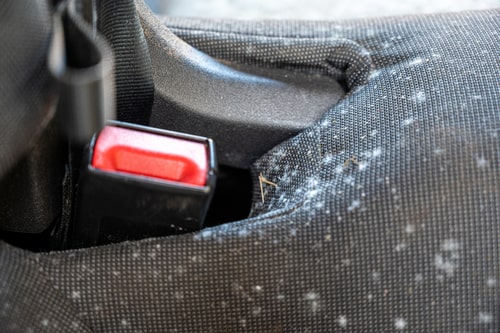
- In cars: Seats, carpeting, trunk liners, and vents can all harbor mold after any water intrusion — a flood, a spilled drink, or sustained humidity.
For definitive identification, a professional inspection or lab-tested sampling is the only way to confirm species. Don't rely on a visual check alone if you're planning remediation.
How to Get Rid of White Mold: Remediation Basics
For small, surface-level patches under about 10 square feet on non-porous surfaces, the EPA notes that homeowners can often handle removal themselves with proper PPE (N95 mask, gloves, eye protection) and an EPA-registered antifungal product.
⚠️ When DIY isn't enough
Anything beyond surface level — or mold on porous materials like drywall, insulation, framing, carpet, or a vehicle interior — calls for professional remediation. Disturbing a colony without containment dramatically increases airborne spore counts and spreads contamination through the whole space.
Professional remediation generally follows a disciplined sequence:
REALITY: a vehicle is not a small house, and it shouldn't be treated like one. The popular “ozone bomb” approach actually degrades the rubber door and trunk seals that keep water out — which is why we use chlorine-dioxide gas instead of ozone. Effective automotive remediation also means finding and fixing the leak, removing and replacing contaminated padding, and purging the ventilation system — not just gassing the cabin and hoping.
This is the whole reason Car Mold Guys exists. We're not detailers who occasionally clean a moldy car — professional vehicle mold remediation is all we do, aligned to the ANSI/IICRC S520 standard, and backed by a 90-day warranty. If you want the full picture of why this matters, here's why car mold should be taken seriously.
Preventing White Mold: Proven Strategies
The best remediation is the kind you never need. Here's how to keep white mold from establishing in the first place:
- Control indoor humidity. Keep relative humidity below 50–60% with dehumidifiers, especially in basements and laundry rooms. A hygrometer costs under $15 and is well worth it.
- Fix water intrusions immediately. A roof leak or plumbing drip creates ideal mold conditions within 24–48 hours. Dry any water damage thoroughly within the first day.
- Improve ventilation. Vent bathrooms, kitchens, and laundry rooms to the exterior — never into the attic — and run exhaust fans during and after high-moisture activities.
- Inspect HVAC systems regularly. Air handlers, condensate pans, and ductwork are common mold habitats; annual professional cleaning meaningfully lowers risk.
- Don't ignore vehicle moisture. A flood, a window left open in the rain, or a musty smell all warrant fast action — automotive mold grows quickly, resists DIY removal, and recirculates through the vents every time you run the air. Most cases trace back to a hidden water leak.
- Clean surfaces regularly. Wipe down humid areas with an antifungal cleaner, paying special attention to grout, window sills, and spots where condensation collects.
Final Thoughts
White mold may not look as alarming as its darker counterparts, but it carries the same structural and health risks. Whether it's Penicillium creeping through basement insulation, Aspergillus colonizing an HVAC system, or Trichoderma quietly eating structural wood, white mold demands prompt identification and action. If you suspect it — in your home or your vehicle — have it assessed, get professional eyes on it, and take remediation seriously. Your indoor air quality, and your health, depend on it.
White Mold in Your Vehicle? Don't Wait for It to Spread.
As the country's only specialists dedicated entirely to vehicle mold remediation, we find the leak, remove the contamination, purge the vents, and verify the air you breathe — backed by a 90-day warranty and 100% mobile service across GA, SC, NC, TN, FL, and AL.
Sources: EPA Mold Course · EPA Mold Cleanup Guide · AAAAI Mold Allergy · WHO Guidelines on Dampness and Mould