

The Impact of Mold on Eye Health: What You Need to Know
Most people think mold only affects the lungs — but your eyes are on the front line every time mold spores are in the air you breathe. Among the body's most sensitive and exposed organs, the eyes have no protective barrier against airborne particles. Every spore that becomes airborne lands on your eyes as readily as it enters your airways.
Whether that mold is behind a damp wall, in a poorly ventilated bathroom, or growing in your vehicle's HVAC system and carpet padding — a far more common scenario than most drivers realize — the spores it releases can trigger a range of eye symptoms. Some are annoying and manageable. Others, left untreated, cause lasting damage. Here's how mold affects eye health, who's most at risk, why vehicles are a frequently missed source, and when symptoms need prompt medical attention.
How Mold Reaches Your Eyes
Mold reproduces by releasing microscopic spores into the air. They're invisible, light enough to stay suspended for hours, and present to some degree in nearly every indoor environment. In a mold-contaminated space — including a vehicle with mold in its interior materials or HVAC system — you're continuously blinking and breathing in those spores.
Why the eyes are uniquely exposed
The respiratory system has mucous membranes and nasal hair that trap at least some of what enters. The eyes have no equivalent defense. Spores that land on the conjunctiva — the clear membrane covering the white of the eye and lining the eyelid — can directly trigger immune responses, inflammation, and in serious cases infection. That's why eye symptoms are often among the first signs of mold exposure people notice.
Four Ways Mold Exposure Affects Your Eyes
These four conditions exist on a spectrum — from common and manageable to rare and medically urgent. This table maps that escalation at a glance:
| Condition | Severity | What It Looks Like |
|---|---|---|
| Irritation & allergy | Common | Redness, itching, watering — the histamine response, like seasonal allergies. |
| Conjunctivitis | Elevated | Pink-eye presentation — often misread as bacterial or viral and mistreated. |
| Dry eye syndrome | Elevated | Gritty sensation, blurring, light sensitivity; can damage the cornea over time. |
| Fungal keratitis | Urgent | A corneal infection needing urgent care; can threaten vision if untreated. |
1. Irritation and allergic reactions
The most common effect — and it ranges from mildly inconvenient to genuinely disruptive. Spores trigger the histamine response behind seasonal pollen allergies: redness, itching, watering, and a sensation like having been in a smoky room. The American Academy of Allergy, Asthma & Immunology identifies mold as a common trigger of allergic eye symptoms — and while outdoor mold peaks in warm, humid months, indoor mold causes problems year-round. For people with diagnosed sensitivities, reactions are more pronounced: swelling around the eyes, burning or stinging, and photosensitivity. If symptoms worsen in a specific environment — particularly your vehicle during or after commutes — and improve when you leave it, mold rather than seasonal allergies may be the cause. The environmental pattern is the key clue.
2. Conjunctivitis (pink eye)
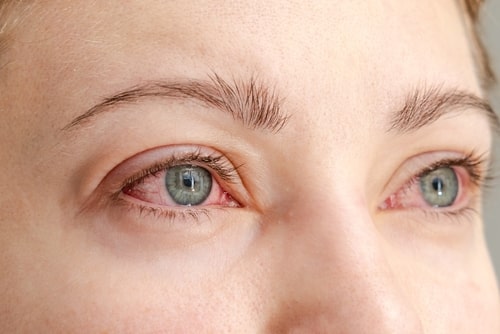
Prolonged or heavy exposure can inflame the conjunctiva, producing classic pink eye: redness, a gritty sensation, and sometimes clear or cloudy discharge. What makes mold-related conjunctivitis tricky is that it's frequently mistaken for bacterial or viral pink eye and treated for the wrong cause. If yours keeps returning, doesn't fully resolve with standard treatment, or recurs in specific environments, sustained mold exposure may be maintaining the inflammation. The Mayo Clinic notes that allergens including mold are a recognized cause of allergic conjunctivitis — so removing the exposure source is part of the treatment, not just medication.
3. Dry eye syndrome
This one surprises people, and it's among the least recognized mold-related effects. Sustained exposure can disrupt the tear film that protects the eye surface, producing a persistent gritty sensation, intermittent blurred vision, light sensitivity, and — paradoxically — episodes of excessive tearing as the eye tries to compensate. Chronic cases can cause microscopic damage to the corneal surface over time. For drivers who spend significant daily time in a mold-affected vehicle, with the HVAC blowing spore-laden air at face level, dry eye can become a daily problem that seems totally unrelated to its actual cause.
4. Fungal keratitis — the most serious consequence
In rarer but far more serious cases, exposure can lead to fungal keratitis — a direct infection of the cornea that requires urgent medical attention. Untreated or inadequately treated, it can progress to corneal scarring, vision impairment, or vision loss. It's most common in people with compromised immune systems, those with recent eye trauma or surgery, and — critically — contact lens wearers. The National Eye Institute confirms fungal eye infections require prescription antifungal treatment and that early diagnosis dramatically improves outcomes.
⚠️ Contact lens wearers: elevated risk
Lenses trap spores directly against the corneal surface, and spores can contaminate a lens case or solution. If you wear contacts and spend significant time in a mold-contaminated environment — including a vehicle with known mold — your risk of fungal keratitis is meaningfully elevated. Consider wearing glasses between identifying the exposure source and completing professional remediation.
Who Faces the Greatest Risk?
|
Mold & allergy sufferers Immune systems already primed to react — even moderate spore levels trigger significant symptoms. |
People with asthma Broader irritant sensitivity means frequent co-occurring eye symptoms; see respiratory effects. |
|
Immunocompromised individuals Highest risk of progressing from irritation to genuine fungal infection. |
Contact lens wearers Lenses hold spores against the cornea — a specifically elevated keratitis risk. |
|
Daily vehicle commuters Anyone spending 50+ minutes daily in a mold-contaminated vehicle — spores continuously recirculated through an HVAC system aimed at occupants' faces — accumulates exposure at a rate that exceeds most other indoor mold environments. |
|
The Connection Most People Miss: Mold in Your Vehicle
The mold source your doctor isn't asking about
If your eye irritation worsens during your commute, clears up on weekends when you drive less, or correlates with a specific vehicle — take that pattern seriously. It's the clearest signal your car is the source.
Car mold hides where drivers never inspect — seat foam, carpet padding, behind door panels, and most critically inside the HVAC system. When the heat or A/C runs, spores blow directly at occupants at face level. Air fresheners and detailing products don't address this; they mask the odor while the colony keeps growing. Standard washing and interior cleaning are not car mold remediation. A proper process eliminates the mold at its source, removes spore-laden materials, neutralizes mycotoxins with chlorine dioxide gas, decontaminates the HVAC system, installs a MERV 13 cabin filter, encapsulates against regrowth, and eliminates the moisture source that enabled the growth. For anyone with eye or respiratory symptoms tied to their vehicle, that's the path to relief — not a new air freshener.
How to Protect Your Eyes from Mold Exposure
Control moisture at the source. Keep indoor humidity below 50%, fix leaks promptly, and address vehicle water intrusion within 24–48 hours. The EPA's mold and moisture guidance is a useful starting resource.
Wear eye protection when cleaning. Safety glasses or goggles when disturbing potentially moldy materials — grout, basement walls, under sinks — prevent direct spore contact during the highest-exposure activity.
Don't rub your eyes, and mind your lenses. Avoid touching your eyes after handling anything in a damp or musty area; wash hands first. In environments with known or suspected mold — including your vehicle — consider glasses over contacts until the source is remediated, and replace lens cases and solution if contamination is possible.
Address vehicle mold professionally. A musty smell, spotting on upholstery or vents, or symptoms that improve away from the car mean it's time for a professional inspection — not a detail shop. It requires the scope only a genuine remediator provides.
When to See an Eye Care Professional
Don't wait for symptoms to escalate — prompt evaluation leads to better outcomes across all four conditions. See an eye care professional if you have any of the following, and mention any known or suspected mold exposure, since that context changes the diagnosis:
|
Redness or irritation lasting more than a few days without a clear cause |
A gritty or foreign-body sensation that OTC drops don't resolve |
|
Any eye discharge — clear, cloudy, or otherwise |
Increased light sensitivity or any change in vision — blurring, halos |
|
Pain in or around the eye warrants same-day evaluation — not a wait-and-see approach. |
|
Caught early, conjunctivitis is managed with topical treatment and keratitis can often be resolved with antifungal drops; left untreated, both can progress to lasting changes in vision. Tell your provider about any environments — home, workplace, or vehicle — where you suspect mold. This article is general information, not medical advice.
“The eyes have no biological defense against airborne particles — which makes them among the first organs to signal a mold problem exists. Protect them by eliminating the source, not by managing symptoms indefinitely.”
The Bottom Line
Mold isn't only a lung problem — it's an eye problem too, ranging from chronic daily irritation to serious infections that threaten vision, any time spores are airborne where people spend significant time. If the pattern of your eye symptoms connects to your vehicle — worse during commutes, better on non-driving days — your car deserves professional evaluation. Eye irritation is one of the most consistent early mold symptoms, and in a sealed cabin where the HVAC distributes spores at face level, the dose accumulates with every commute. When the source is your car, Car Mold Guys can eliminate it properly.
Eye Symptoms Tied to Your Commute?
Car Mold Guys provides complete professional vehicle mold remediation — moisture-source identification and repair, HEPA extraction, chlorine dioxide mycotoxin treatment, contaminated-material removal, full HVAC decontamination, and verified air quality. 100% mobile to your door, backed by a 90-day warranty across GA, SC, NC, TN, FL, and AL.
This article is general information, not medical advice; consult an eye care professional about persistent or worsening eye symptoms. Sources: AAAAI · Mayo Clinic · National Eye Institute · EPA