
Can Mold Really Grow on Glass, Metal, and Plastic? The Truth About Mold on Inorganic Surfacesutrient Source
If you've ever noticed dark spots on a bathroom tile, a fuzzy coating on a window sill, or a musty smell coming from your car's air vents, you've seen mold do something that defies common sense: grow on a surface that technically can't feed it.
Most people assume mold only attacks wood, drywall, or fabric. But mold is far more opportunistic than that. It will colonize glass, metal, plastic, concrete, and tile — surfaces we think of as "safe" — if the conditions are even slightly in its favor. Understanding how and why this happens is the first step toward stopping it.
Let's break it all down.
What Is Mold, and What Does It Actually Need to Survive?
Mold is a type of fungus that reproduces by releasing microscopic spores into the air. Those spores are essentially everywhere — in your home, your car, your office, and outdoors. They float invisibly until they land on a surface that gives them what they need to germinate and grow.
According to the EPA's mold guidelines, mold requires four basic things to thrive:
- Mold spores (already present in virtually every environment)
- A food source (organic material)
- Moisture
- The right temperature
Here's where inorganic surfaces enter the picture — and why the story gets more complicated than most people realize.
Why Inorganic Surfaces Aren't Actually "Mold-Proof"
Glass, metal, ceramic tile, plastic, and concrete cannot be consumed by mold. Mold lacks the enzymes to break down truly inorganic compounds. So why does mold still grow on them?
Because mold doesn't eat the surface — it eats what's on the surface.
Dust settles everywhere. Grease, fingerprints, soap residue, cooking splatter, pollen, and skin cells accumulate on every surface in your environment, including non-porous ones. That thin, often invisible layer of organic grime is all mold needs to establish a foothold.
Think about it this way: a glass shower door doesn't feed mold, but the soap scum clinging to it absolutely does.
The 6 Conditions That Allow Mold to Grow on Inorganic Surfaces
1. Organic Matter Accumulation
This is the non-negotiable factor. No matter how "clean" a surface looks, organic residue builds up over time. Common culprits include:
- Dust and dirt particles containing dead skin cells and pollen
- Grease and cooking oils on kitchen surfaces
- Soap scum and body oils in bathrooms
- Condensation residue that carries dissolved organics
- Environmental grime on outdoor or vehicle surfaces
In automotive environments specifically, the combination of dust, humidity, and organic debris inside car interiors makes non-porous surfaces — dashboards, glass, plastic trim — surprisingly vulnerable. This is something the team at Car Mold Guys sees regularly: mold thriving on hard surfaces inside vehicles where trapped moisture and organic buildup create the perfect storm.
2. Moisture and Humidity
Moisture is the single most controllable mold trigger. Even a thin film of water on a surface can be enough for mold spores to germinate. Moisture reaches inorganic surfaces through:
- Condensation: When warm, humid air contacts a cooler surface, water droplets form. This is common on windows, metal pipes, and HVAC components.
- Leaks: Plumbing failures, roof leaks, or window seal failures introduce water to surfaces that would otherwise stay dry.
- High ambient humidity: Environments above 60% relative humidity put virtually every surface at risk.
The CDC notes that controlling moisture is the most effective strategy for preventing mold growth in any environment.
3. Temperature Range
Mold is most active between 60°F and 80°F (16°C–27°C), which happens to overlap almost perfectly with typical indoor and vehicle interior temperatures. Some species can grow in cooler conditions — as low as 40°F — meaning even refrigerated or climate-controlled spaces aren't immune.
4. Poor Ventilation
Stagnant air allows moisture to linger and organic particles to settle undisturbed. Well-ventilated spaces dry faster and circulate fewer concentrated spores. This is why closed-up rooms, cars left sitting with windows up, and poorly ventilated HVAC systems are such common sites for mold problems.
5. Surface Texture and Porosity
Not all inorganic materials are equally resistant. There's a meaningful difference between:
- Smooth, non-porous surfaces (glass, stainless steel, glazed ceramic): Harder for mold to grip. Easier to clean. Less likely to harbor long-term colonies.
- Rough or porous inorganic surfaces (unglazed concrete, brick, grout, certain plastics): These trap moisture and organic particles in microscopic crevices, making them much more hospitable to mold.
Grout is a perfect example. The tile itself may be fully glazed and mold-resistant, but the grout joints between tiles are porous, rough, and perpetually exposed to moisture and soap — which is why grout lines are almost always where mold appears in bathrooms.
6. Time
Mold doesn't colonize overnight in most cases. It takes time for spores to germinate, establish, and spread. Surfaces that stay wet and dirty for extended periods are at far greater risk than those that are regularly cleaned and dried. This is especially relevant for vehicles that sit unused for weeks or months.
Common Inorganic Surfaces Where Mold Shows Up
| Surface | Why Mold Grows There |
|---|---|
| Bathroom tiles and grout | Soap scum + moisture + porous grout joints |
| Window glass and frames | Condensation + dust accumulation |
| Metal pipes and HVAC ducts | Condensation + dust + low light |
| Car dashboards and trim | Trapped humidity + dust + organic debris |
| Concrete basement walls | Moisture infiltration + surface dust |
| Plastic storage bins | Dust + enclosed humid environments |
| Refrigerator door seals | Condensation + food residue |
Mold on Inorganic Surfaces in Vehicles: A Special Case
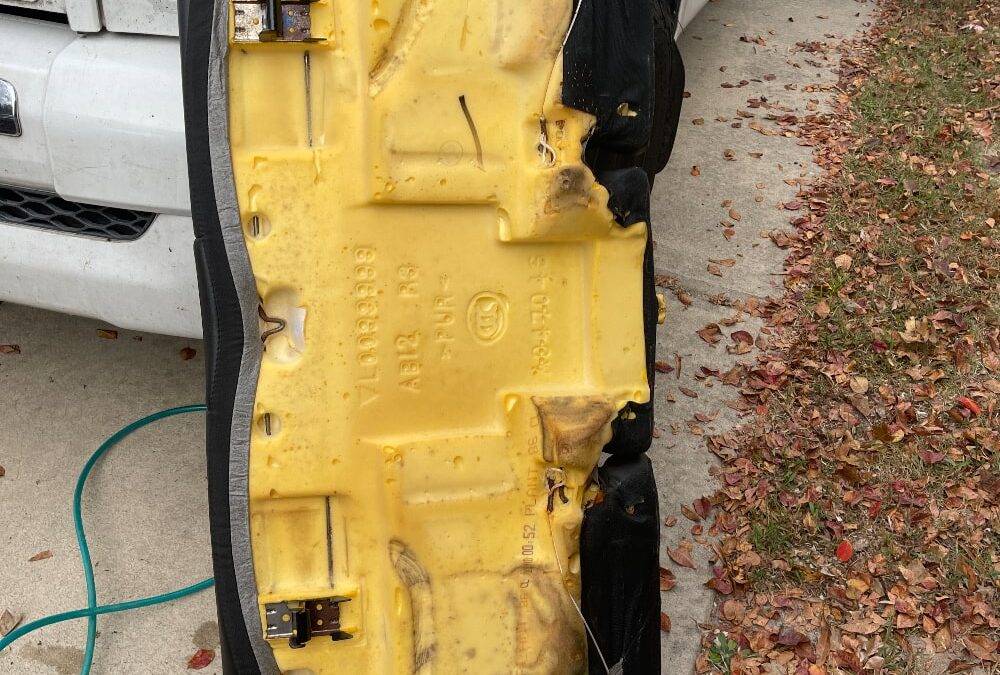
Vehicles present a uniquely challenging mold environment. Car interiors combine hard plastic, glass, and metal with soft materials like carpet and seat foam — creating a mix of surfaces that respond very differently to moisture.
What many people don't realize is that even the hard, non-porous surfaces in a vehicle — the windshield, dashboard plastic, door panels, and vents — can support mold growth when the car experiences a water intrusion event (a forgotten window, a sunroof leak, a flood). The moisture saturates the air inside the cabin, coats every surface, and provides the humidity needed for spores to germinate on whatever organic material is present.
The HVAC system is particularly problematic. Evaporator coils inside the air conditioning unit condense moisture as part of normal operation. Dust entering through the vents settles on those wet coils and on duct surfaces. Over time, this produces mold inside the duct system — which then blows spores directly into the cabin every time the fan runs.
If you notice a musty smell when you turn on your car's air conditioner, that's not a coincidence. That's mold on inorganic surfaces inside your HVAC system.
How to Prevent Mold on Inorganic Surfaces
Prevention is significantly less expensive — and less disruptive — than remediation. Here's what actually works:
Control moisture first. This is the highest-leverage action. Fix leaks promptly, use a dehumidifier in spaces that run above 60% humidity, and ensure proper ventilation in bathrooms, kitchens, and basements. The FEMA mold prevention guide recommends addressing any water intrusion within 24 to 48 hours before mold has a chance to establish.
Clean regularly and thoroughly. Remove the organic film that mold feeds on. In bathrooms, this means cleaning grout and tile surfaces with appropriate cleaners and rinsing soap residue after use. In kitchens, it means wiping down all surfaces, not just the obviously dirty ones. In vehicles, it means vacuuming and wiping down hard interior surfaces regularly.
Improve air circulation. Open windows when weather permits, run exhaust fans in moisture-prone areas, and have HVAC systems serviced annually. In vehicles, run the air conditioner on fresh air mode periodically to dry out the evaporator.
Dry surfaces promptly. Don't let water sit on any surface — porous or not. Wipe condensation from windows, dry bathroom surfaces after use, and address wet floors or upholstery immediately.
Use mold-resistant coatings where appropriate. For concrete, brick, and other porous inorganic surfaces in high-moisture environments, mold-resistant sealants add a meaningful layer of protection. Grout sealers in bathrooms and garages are a cost-effective preventive measure.
When Prevention Fails: Recognizing and Addressing Mold on Inorganic Surfaces
Mold on inorganic surfaces is often easier to clean than mold that has penetrated porous organic materials, because it hasn't embedded itself into the substrate. However, visible mold on a hard surface often signals that mold has already spread to nearby porous materials — insulation, wood framing, carpet — that are out of sight.
If you find mold on inorganic surfaces in your home, treat it as a symptom rather than the whole problem. Clean the visible growth, but investigate the moisture source and check surrounding materials. The EPA recommends professional assessment for contaminated areas larger than 10 square feet.
For vehicle mold, the same principle applies. What you can see on the dashboard or glass is rarely the full extent of the problem. Mold inside vehicles typically involves the HVAC system, carpet padding, and seat foam — materials that require professional-level treatment to properly remediate.
Key Takeaways
Mold doesn't need to eat a surface to grow on it — it only needs moisture, warmth, organic residue, and time. Inorganic surfaces like glass, metal, and plastic provide no nutrition on their own, but the thin layer of everyday grime that coats these surfaces is more than enough to support a mold colony.
The good news is that inorganic surfaces, particularly smooth and non-porous ones, respond well to proper cleaning and moisture control. The effort required to prevent mold on these surfaces is far less than the effort required to remediate a full-blown infestation.
Stay ahead of it: control moisture, clean consistently, and address any water intrusion immediately. If mold has already taken hold — especially inside a vehicle — professional remediation is the most reliable path to a complete resolution.
Have questions about mold in your vehicle? Car Mold Guys specializes in mobile auto mold remediation throughout Georgia. Contact us for a consultation.